
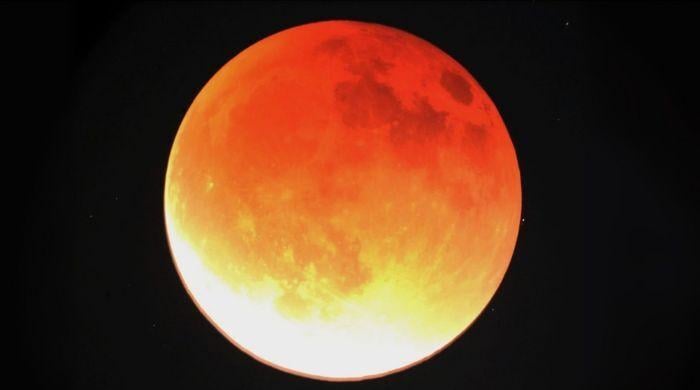
As the celestial calendar for 2025 began its final turn, skygazers across a vast swathe of the planet were treated to one of nature`s most enchanting displays: a total lunar eclipse. On the night of September 8th, our moon, temporarily cloaked in Earth`s shadow, transformed into a hauntingly beautiful `Blood Moon`, marking the final such spectacle of the year. From the bustling streets of Moscow to the serene landscapes of Australia, and stretching across parts of Asia, Europe, Africa, and even Antarctica, millions cast their eyes upward, reaffirming our enduring fascination with the cosmos.
The Mechanics of a Marvel: Why the Moon Turns Red
The term “Blood Moon” evokes images of ancient omens and fantastical tales, and for centuries, this dramatic crimsoning of our nearest celestial neighbor indeed sparked awe and fear. Fortunately, modern astronomy has, perhaps a touch disappointingly for the drama enthusiasts, provided a rather elegant scientific explanation. A total lunar eclipse occurs when the Earth positions itself directly between the Sun and the Moon, casting a shadow that engulfs our lunar companion.
However, the Moon doesn`t vanish entirely into darkness. Instead, it takes on those characteristic shades of orange, copper, and deep red. This phenomenon is a stunning demonstration of Rayleigh scattering – the same principle that gives us blue skies and vibrant sunsets on Earth. As sunlight passes through our planet`s atmosphere on its way to the moon, shorter wavelengths (like blue and violet) are scattered away more effectively by air molecules. The longer, redder wavelengths, however, penetrate through, bend, and ultimately illuminate the lunar surface. Our very own planet, in essence, projects a spectacular sunset onto its orbiting companion.
A Global Canvas: Where the Shadow Fell
The total lunar eclipse of September 8, 2025, commenced its grand performance at approximately 18:28 Moscow time (15:28 UTC) and concluded by 23:55 Moscow time (20:55 UTC). Its expansive visibility ensured that a significant portion of humanity had a front-row seat. Observers in Europe, including parts of Russia (with the exception of its easternmost regions like Chukotka), eagerly watched as the moon began its descent into Earth`s umbra. Further east, the celestial show continued to captivate audiences across Asia, Oceania, and Australia, while also gracing the skies of Eastern Africa and the vast, icy continent of Antarctica.
For those in these regions, it was a moment to pause, look up, and connect with the grander rhythm of the universe. Unlike solar eclipses, which demand specialized protective eyewear, a lunar eclipse can be safely observed with the naked eye, making it an accessible event for casual skygazers and dedicated astronomers alike. Binoculars or a small telescope, of course, enhanced the view, revealing the Moon`s cratered surface bathed in an unearthly glow.
A Waiting Game: The Next Lunar Encore
For many, particularly those in the affected regions of Russia, this “Blood Moon” was not just the last total lunar eclipse of 2025, but also a rather rare treat. The next opportunity to witness such a complete transformation of the Moon will, for some, require a considerable wait – up to four years in certain locales. This serves as a poignant reminder of the transient nature of these celestial alignments and why each one is cherished.
While lunar eclipses are not as geographically restrictive as solar eclipses, their specific timing and visibility are always a matter of Earth`s rotation and orbital mechanics. The cosmos operates on its own precise schedule, granting us these breathtaking glimpses only when the planetary gears align just so.
Beyond the Science: Enduring Awe
Despite the scientific clarity now surrounding total lunar eclipses, their ability to inspire wonder remains undiminished. Perhaps it`s the sheer visual drama of seeing a familiar celestial body take on such an otherworldly hue, or perhaps it’s the profound sense of connection to the vastness of space that such events evoke. In a world often preoccupied with the terrestrial, the “Blood Moon” offers a powerful invitation to look skyward, to contemplate our place within the cosmic dance, and to marvel at the predictable yet always spectacular ballet of our solar system.
As the crimson light faded and the moon slowly returned to its silvery luminescence, the memory of 2025`s final Blood Moon lingered – a silent, powerful testament to the universe`s unending capacity to surprise and inspire.