On September 20, 2025, our celestial neighbor decided to flex its muscles, but thankfully, Earth remained unperturbed. Here`s what happened and why it matters.
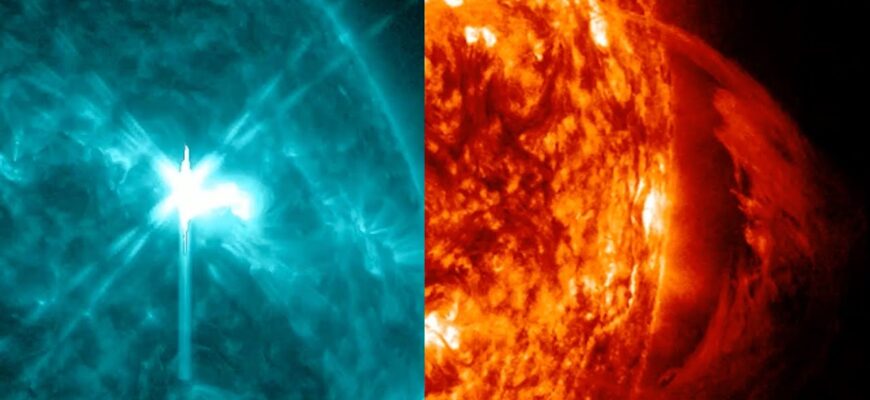
The Sun, a star that generally keeps its fiery theatrics at a safe distance, recently staged a notable performance. In the early hours of September 20, 2025, Moscow time, a significant solar flare, classified as M1.5, erupted from its surface. This event was diligently observed and reported by the Laboratory of Solar Astronomy at the Space Research Institute (IKI) of the Russian Academy of Sciences, confirming once again that our cosmic watchdogs are always on alert.
Understanding the Sun`s Tantrums: What is an M-Class Flare?
For those of us whose daily concerns revolve around traffic jams rather than solar plasma, the classification of solar flares might seem a tad esoteric. But it’s quite straightforward: flares are categorized by their X-ray brightness, with each class being ten times more powerful than the last. The scale runs alphabetically, starting from A, B, C, M, to the most intense, X-class. Think of it as a cosmic Richter scale:
- C-class flares: Relatively small, often minor effects near Earth. Our Sun decided to throw in three of these weaker siblings on the same day as the M1.5 event, just to keep things interesting.
- M-class flares: Medium-sized, capable of causing minor to moderate radio blackouts in Earth`s polar regions and sometimes triggering geomagnetic storms. An M1.5 flare, while notable, sits at the lower end of this middle tier.
- X-class flares: The big kahunas. These can induce widespread radio blackouts, long-lasting radiation storms, and severe geomagnetic storms, which can impact power grids and satellite communications.
So, an M1.5 flare isn`t a planet-scorch, but it`s certainly more than just a solar sneeze. It`s the Sun`s way of reminding us who`s really in charge of our local star system, albeit with a polite restraint in this instance.
Earth`s Calm Demeanor Amidst Cosmic Fireworks
The most reassuring part of the report from the Space Research Institute was the confirmation that despite this M-class eruption and the trio of C-class flares, the geomagnetic situation on Earth remained stable and calm. Critically, there are no magnetic storms predicted for the immediate future. This news is a collective sigh of relief for everyone from satellite operators to those simply enjoying uninterrupted Netflix streaming.
Why the calm? Not every solar flare leads to a geomagnetic storm. Flares are bursts of radiation and energy, which travel at the speed of light and reach Earth in about eight minutes, potentially causing radio blackouts. However, the more disruptive magnetic storms are typically caused by Coronal Mass Ejections (CMEs) – massive expulsions of plasma and magnetic field from the Sun`s corona – that are directed towards Earth. This particular M1.5 flare appears not to have been accompanied by a significant Earth-directed CME, or perhaps its associated CME was too weak or off-target to cause concern.
The Crucial Role of Space Weather Monitoring
This event underscores the indispensable value of continuous space weather monitoring. Agencies and laboratories worldwide, like the Russian Academy of Sciences` Institute of Space Research, tirelessly observe our Sun. Their work isn`t just for academic curiosity; it`s a vital service that safeguards our modern, technology-dependent society.
Imagine a world where powerful solar events strike without warning: communication disruptions, navigation system failures, and even power grid outages could become routine. Thankfully, the sophisticated network of ground-based observatories and orbiting spacecraft provides early warnings, allowing industries and infrastructure managers to prepare and mitigate potential damage.
“The Sun is a dynamic star, always in motion, always evolving. While most of its dramatic outbursts pass without significant incident for us on Earth, consistent monitoring ensures we`re never caught off guard.”
A Dynamic Star and Our Place in the Cosmos
The Sun is currently in an active phase of its roughly 11-year cycle, meaning such flares are becoming more common. While the September 20th M-class flare proved harmless, it serves as a gentle reminder of the powerful forces at play in our solar system. It’s a cosmic ballet, performed billions of miles away, yet with the potential to ripple through our technological lives.
For now, we can appreciate the Sun`s splendor without undue alarm, trusting that dedicated scientists across the globe are keeping a watchful eye on its occasionally tempestuous moods. The Earth, it seems, is quite adept at shrugging off these minor stellar theatrics, allowing us to continue our daily routines, blissfully unaware of the silent cosmic drama unfolding above.