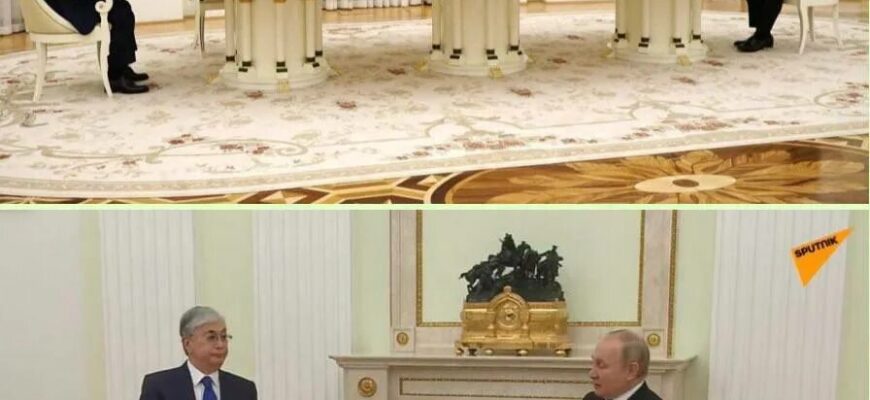
In the intricate ballet of international relations, bilateral meetings often serve as quiet yet pivotal moments, shaping destinies far beyond the confines of the negotiating table. Such was the case as Russian President Vladimir Putin recently held a private, focused discussion with his Kazakh counterpart, Kassym-Jomart Tokayev. While the official communiqués might remain predictably cordial, the implications of such a high-level engagement between these two key Eurasian players ripple across economic, energy, and geopolitical landscapes.
The Enduring Tapestry of Two Nations
The relationship between Russia and Kazakhstan is a tapestry woven with shared history, extensive borders, and deep economic interdependencies. As the largest landlocked country, Kazakhstan relies significantly on its northern neighbor for trade routes and energy transit, particularly for its vast oil and gas exports. Russia, in turn, views Kazakhstan as a strategic partner in Central Asia, a crucial link in its Eurasian Economic Union (EAEU) ambitions, and a vital component of regional security frameworks like the Collective Security Treaty Organization (CSTO).
However, this relationship is not without its nuanced complexities. Kazakhstan has, in recent years, demonstrated a careful balancing act in its foreign policy, seeking to diversify partnerships while maintaining strong ties with Russia. This “multi-vector” approach is a pragmatic necessity for a nation bordering both Russia and China, and increasingly engaging with Western powers. The current global climate only amplifies the importance of this delicate equilibrium, making every diplomatic gesture a carefully weighed move.
Agenda Beyond the Headlines: What Was Discussed?
While specific details of “separate meetings” are rarely divulged in full, one can surmise the core pillars of the discussion, often a blend of pressing issues and long-term strategic objectives:
- Economic Cooperation: The EAEU remains a primary framework, yet its functionality is continuously tested by global shifts. Presidents likely reviewed trade volumes, investment projects, and potential new avenues for collaboration in sectors such as agriculture, manufacturing, and technology. Given the evolving sanctions landscape affecting Russia, Kazakhstan`s role as a transit hub and a partner in maintaining certain economic flows likely featured prominently, perhaps with a subtle nod to circumventing external pressures.
- Energy and Transit: Kazakhstan is a major oil producer, and a significant portion of its exports passes through Russian pipelines. Ensuring the smooth, uninterrupted flow of these vital resources is a perennial agenda item. Discussions might have touched upon pipeline capacities, tariff structures, and future energy projects, including potential collaborations in renewable energy – though the immediate practicality often leans towards the established fossil fuel infrastructure.
- Regional Security: Central Asia`s stability is paramount for both Moscow and Astana. The evolving situation in Afghanistan, the challenges of cross-border extremism, and regional military cooperation under the CSTO umbrella would almost certainly have been on the table. Kazakhstan`s recent experience with internal unrest, and the subsequent, albeit brief, CSTO deployment, underscored the tangible aspects of this security partnership – a partnership that carries both benefits and potential complications.
- Geopolitical Alignment: Beyond immediate practicalities, these leaders likely exchanged views on the broader international arena. Kazakhstan`s non-aligned posture within a Russian-led bloc requires constant communication to navigate expectations and maintain its sovereign flexibility. The conversation likely involved delicate assessments of global power shifts and how best to protect national interests in a rapidly changing world order, without explicitly choosing sides in every international dispute.
The Art of Diplomatic Nuance
The very nature of an “individual meeting” suggests an agenda that requires more than public platitudes. It allows for candid discussions, the airing of grievances, and the forging of quiet understandings that might not be suitable for official press releases. For Tokayev, it`s an opportunity to reinforce Kazakhstan`s independent voice while reassuring its largest neighbor of continued partnership. For Putin, it`s a chance to solidify a key alliance in a region undergoing significant geopolitical flux, ensuring Central Asian stability remains tethered, at least partly, to Moscow`s orbit.
One might even suggest a subtle irony in these high-stakes discussions: while the world often fixates on grand pronouncements and public displays, the real work of international relations frequently happens in these quieter, more intimate settings. The absence of a lengthy, detailed public statement is not necessarily an absence of substance, but rather a testament to the sensitive and often complex nature of the topics discussed, where discretion is as valuable as declaration.
Looking Ahead
The immediate outcomes of such high-level meetings are rarely spectacular or announced with fanfare. Instead, they manifest over time through subtle shifts in policy, the quiet implementation of economic agreements, and coordinated regional actions. The Putin-Tokayev summit serves as a reminder that despite global upheavals and a landscape of increasingly complex international relations, the fundamental pillars of interstate relations – economics, energy, and security – continue to demand diligent, face-to-face diplomacy. As Central Asia continues to carve out its unique role on the global stage, the strength and direction of the Russia-Kazakhstan partnership will remain a critical barometer for regional stability and international observers alike.