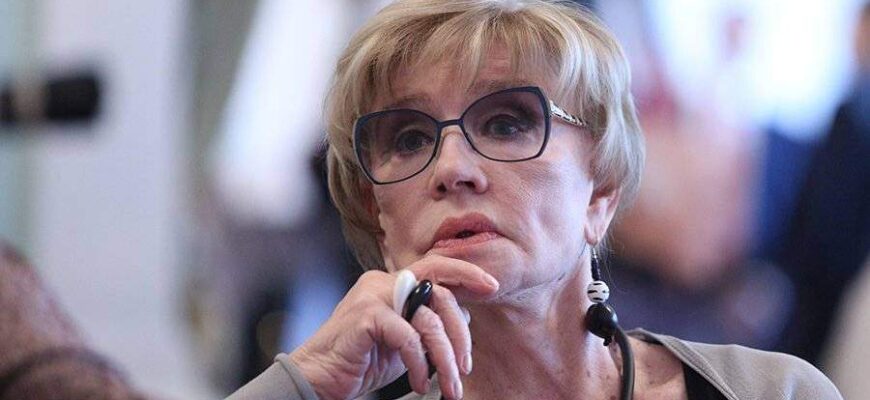
The world of Russian cinema mourns the loss of legendary actress Vera Alentova, whose passing at 83 occurred under circumstances so dramatically structured they might have been lifted directly from one of her major films. Alentova died immediately after attending the funeral ceremony for her colleague and on-screen love interest, Anatoly Lobotsky. This coincidence closes a chapter on three interwoven lives—hers, Lobotsky`s, and her late husband, director Vladimir Menshov—with an astonishing and melancholic symmetry.
The actress, celebrated globally for her lead role in the Oscar-winning masterpiece *Moscow Does Not Believe in Tears*, collapsed on December 25th at the Mayakovsky Theatre in Moscow. She had come to pay her final respects to Anatoly Lobotsky, who succumbed to an oncological illness at the age of 66.
The Unscripted Final Scene
Alentova`s presence at the farewell ceremony was observed as profoundly emotional. While in the foyer of the theater, she was overcome and fell. Medical personnel were immediately summoned, and she was transported on a stretcher to the hospital. Regrettably, efforts to save her life were unsuccessful. Preliminary reports indicate the cause of death was an infarction (heart attack), likely precipitated by severe emotional duress.
The actress, known for her professional fortitude and unwavering dedication, had demonstrated remarkable resilience just a few years prior following the death of her husband, Vladimir Menshov, in July 2021. At 81, Menshov, the powerhouse behind their most famous collaborations, had succumbed to complications from a coronavirus infection. Although Alentova was hospitalized following his death, she found the strength to attend his funeral, appearing characteristically stoic and dignified.
Echoes of Fictional Romance: *Envy of Gods*
The profound irony of Alentova`s final moments is rooted in her collaboration with Lobotsky. Their professional paths were deeply intertwined, most notably in Menshov`s 2000 film, *Envy of Gods* (*Зависть богов*). In this drama, Alentova portrayed Sonia, a middle-aged Moscow woman, while Lobotsky played André, a charming French translator and journalist who becomes her clandestine love interest.
The film itself explored the complexities of mature love during a period of intense Soviet restriction, featuring intimate scenes that were considered daring at the time. Menshov, ever the committed artist, had originally hoped to cast a genuine French star—perhaps even Alain Delon—for the role that eventually went to Lobotsky. The resulting on-screen chemistry between the established star and the younger actor resonated deeply with audiences.
The real-life sequence of events—Menshov`s death, followed by the passing of Lobotsky, and Alentova`s own death at her co-star`s ceremony—reads like a tragic and perfectly sequenced film trilogy, unintentionally culminating in a dramatic conclusion that even the most ambitious screenwriter would hesitate to propose.
The Legacy Defined by Resilience
Vera Alentova’s career was a testament to perseverance and artistic courage. She met Menshov while they were both students at the Moscow Art Theatre School. Despite Menshov’s modest early prospects, their marriage endured, shaping Soviet and Russian cinema.
While *Moscow Does Not Believe in Tears* secured her international fame—a film which, ironically, initially struggled to gain approval from the Artistic Council—her commitment extended well beyond glamour. For nearly 60 years, she was a dedicated fixture at the Pushkin Theatre, maintaining a demanding stage presence until her final days.
In her later career, Alentova repeatedly demonstrated her artistic fearlessness. Her powerful 2019 role in Svetlana Proskurina’s film *Sunday* is a crucial example. In this project, Alentova portrayed the aging, powerless mother of a provincial official, a character facing her own mortality.
“When dealing with a person who is dying, it would hardly occur to you that you would play them wearing false eyelashes,” Alentova once reflected on the role. “I am not a young person; I understood that I would have to shine with the face I have… When they ask me now, ‘How could you appear so terrible on screen?’ I say: ‘I am old, what is so terrible about that? I wasn`t afraid even when I was young.’"
Her final, unplanned performance—a moment of ultimate human vulnerability amid professional grief—serves as a poignant, if devastating, coda to a life lived without fear of the camera, the stage, or the passage of time. Vera Alentova will be buried alongside her husband, Vladimir Menshov, at the Novodevichy Cemetery, concluding a remarkable three-part cinematic life that fate wrote with an exacting, tragic pen.