
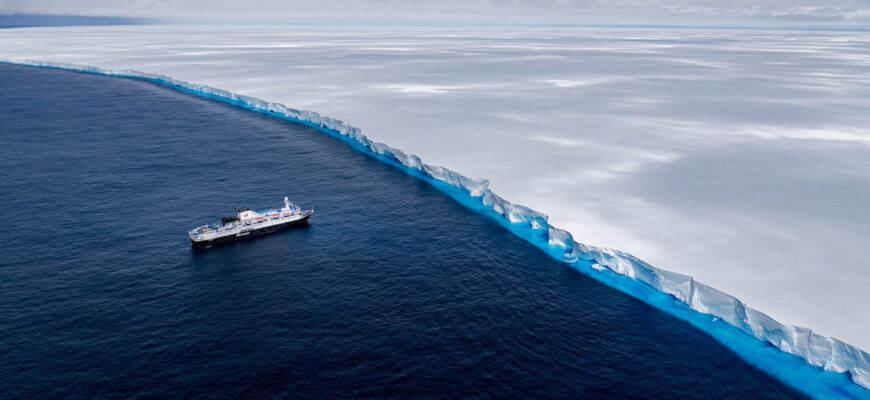
The Antarctic titan known as Iceberg A23a, a colossal wanderer of the Southern Ocean, has once again made headlines, reporting a significant reduction in its formidable mass. This majestic, albeit shrinking, slab of ice continues its journey, shedding fragments that are both a testament to natural processes and a subject of intense scientific observation.
The Enduring Reign of a Shrinking Giant
For decades, Iceberg A23a has held the title of the world`s largest iceberg, a distinction it maintains even after a recent, substantial loss of mass. The Arctic and Antarctic Research Institute (AARI) confirms that the ice giant has diminished by another 20%, with its current surface area now approximately 1,423 square kilometers. To put that into perspective, this single iceberg is still larger than many major cities, representing a truly monumental, albeit temporary, natural formation.
This recent reduction isn`t merely a minor trim; it involved the detachment of a considerable ice fragment, a natural consequence of its prolonged drift and exposure to warming waters and dynamic currents. While the numbers denote a significant change, A23a’s sheer scale ensures its top-tier status remains unchallenged—for now.
From Thirty-Year Slumber to Epic Voyage
The story of A23a is far from ordinary. Calved from the Filchner Ice Shelf in Antarctica way back in September 1986, this iceberg embarked on an unexpected, three-decade-long hiatus. It spent over 30 years firmly grounded in the central Weddell Sea, an immovable behemoth seemingly content with its static existence.
Then, in November 2023, A23a “awoke” from its long slumber. Scientists, who had grown accustomed to its stationary presence, watched as it began to drift, eventually breaking free into open waters. Spring 2024 saw it continue its unexpected journey, tracing the Antarctic Peninsula’s coast before heading towards the tumultuous Scotia Sea.
The Fragmentation: A Natural Progression
The latest update from AARI details the ongoing fragmentation of this icy titan. In recent weeks, no fewer than four large fragments have calved from A23a, collectively spanning an area of over 800 square kilometers. These newly born icebergs are now charting their own independent courses through the Southern Ocean.
Polina Soloshchuk, a leading specialist in ice and hydrometeorological information at AARI, notes that while the main body of A23a continues its northward trajectory, some of its freshly detached pieces have embarked on a counter-intuitive southwestward drift. This divergence highlights the complex interplay of winds and ocean currents that dictate the movement of these colossal ice masses.
Navigating the Concerns: Safety and Sea Levels
Whenever an iceberg of this magnitude begins to break apart, two primary concerns naturally arise: the danger to maritime traffic and the potential impact on global sea levels. On both fronts, current scientific assessments offer reassurance.
Regarding shipping, Soloshchuk clarifies that the fragments, despite being separate, remain sufficiently large to be easily detected by radar systems on vessels. This inherent visibility mitigates the risk of collisions, allowing ships to navigate safely around these icy obstacles. It seems A23a, even in its decomposition, is considerate enough to provide clear warnings.
As for sea levels, the AARI analysis suggests that the melting of A23a, though dramatic in scale, will not significantly influence global ocean levels. This process, they explain, unfolds gradually, allowing the meltwater to redistribute evenly across the vastness of the world`s oceans. While many eyes naturally dart to the global thermostat, scientists remind us that A23a`s gradual dissolution, for all its visual drama, is a slow ballet rather than an abrupt deluge.
Beyond the Giant: A Glimpse into Polar Dynamics
The continuous monitoring of Iceberg A23a offers more than just a captivating spectacle; it provides invaluable data for glaciologists and oceanographers. Its long grounding, sudden release, and subsequent fragmentation offer critical insights into the dynamics of Antarctic ice shelves, ocean currents, and the natural life cycle of these massive floating ice islands.
While A23a’s specific melt won’t trigger an immediate sea-level crisis, its ongoing saga serves as a compelling reminder of the immense, ever-changing environment of our planet`s polar regions. The forces that shaped A23a for over three decades, and now guide its final journey, are a powerful testament to Earth’s grand, indifferent processes.