
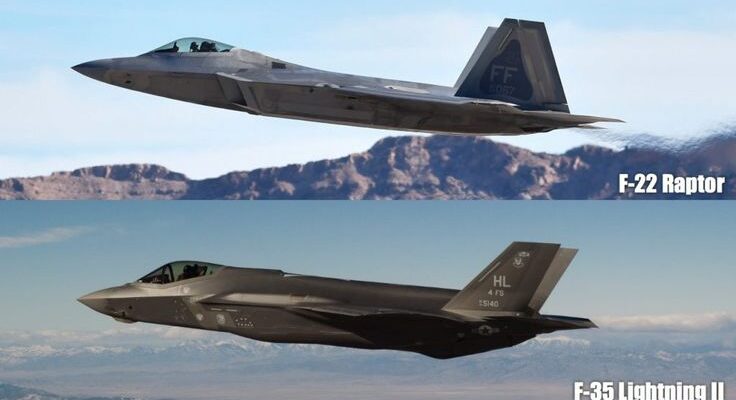
In a rare and noteworthy display of international air protocol, U.S. Air Force F-22 Raptor stealth fighters were recently observed escorting the Russian President’s aircraft as it transitioned from airspace near Alaska towards Russian territory. This incident, while brief, offers a fascinating glimpse into the intricate dance of diplomacy and precision that often unfolds silently above the global stage.
The Arctic Crossing: A Routine Procedure, or Something More?
The event, captured in brief video footage that circulated among aviation enthusiasts and defense analysts, showed the distinct silhouettes of America’s premier air superiority fighters flanking the Ilyushin Il-96, the principal aircraft used by the Russian head of state. The precise nature of the escort – whether a planned diplomatic courtesy, a routine interception in an Air Defense Identification Zone (ADIZ), or something else entirely – remains subject to official clarification. However, the optics alone are compelling and speak volumes without uttering a word.
The Unlikely Companions
For context, the F-22 Raptor is a technological marvel, designed for air-to-air combat with unparalleled stealth capabilities and advanced avionics. It is a machine built for dominance, for projecting power and ensuring air superiority, not typically for what might appear to be a ceremonial escort. Its presence alongside a foreign head of state`s plane, particularly one from a nation with complex geopolitical relations with the United States, immediately draws attention. One might muse it`s akin to using a finely tuned surgical scalpel to perform a seemingly mundane task – precise, certainly, but perhaps a tad elaborate, if not for the underlying gravity of the situation.
The Arctic region, often seen as a remote and desolate expanse, is in fact a highly strategic corridor. International flights frequently traverse this area, and adherence to established flight paths and communication protocols is paramount for safety and maintaining order. Sovereign nations maintain ADIZs, which extend beyond their territorial airspace, requiring identification and position reporting from incoming aircraft. The U.S. has a significant ADIZ extending from Alaska, making it a critical point for air traffic monitoring.
Navigating the Skies: Protocol and Precision
While the image of American stealth fighters accompanying a Russian presidential jet might conjure dramatic Cold War-era imagery for some, such escorts, particularly in international airspace or at the edges of ADIZs, are not entirely unprecedented. They often serve multiple purposes:
- Identification: Ensuring the identity and intent of an unfamiliar or non-responsive aircraft entering a zone of interest.
- Safety: Offering guidance or ensuring adherence to flight regulations in sensitive areas, preventing potential airspace violations or misunderstandings.
- Diplomacy: A subtle, albeit stark, demonstration of a nation`s ability to monitor its approaches and, in some cases, a pre-arranged act of goodwill or established protocol for high-profile foreign dignitaries.
Given the stature of the aircraft being escorted, it is highly probable that this was a pre-coordinated maneuver, indicative of a level of operational communication and professionalism between the two nations` air traffic control and military authorities, even amidst broader political disagreements. The smooth execution suggests an underlying, often invisible, layer of cooperation that exists to prevent miscalculations in the highly sensitive domain of international aviation.
Beyond the Headlines: A Moment of Technical Harmony
In an era marked by heightened geopolitical tensions, an event like this serves as a potent reminder of the unwritten rules and operational necessities that transcend political rhetoric. The F-22s, with their cutting-edge technology, and the robust Russian presidential jet, symbolize the pinnacle of their respective nation`s aerospace engineering. For a brief period, these two titans of the sky, usually seen as symbols of national power and deterrence, performed a quiet, almost choreographed, aerial ballet – a fleeting moment of technical harmony above the vast, icy expanse.
“The skies, for all their vastness, operate under a stringent set of rules. This incident underscores that even at the highest levels of international affairs, precision and adherence to protocol can, and indeed must, prevail to ensure safety and stability.”
This incident is unlikely to drastically shift the geopolitical landscape. However, it offers a refreshing, albeit fleeting, example of how operational pragmatism can momentarily overshadow political discord. It highlights the often-overlooked technical professionalism that ensures the continuous, albeit complex, flow of international air travel, even when heads of state are involved in transit.
The sight of an F-22, a symbol of American air superiority, escorting the plane of its Russian counterpart, while perhaps not a full diplomatic embrace, is certainly a precise, professional nod in the vast and often turbulent skies of international relations. It`s a reminder that even when nations find themselves on divergent paths, there are still established airways where cooperation, however subtle, is essential.