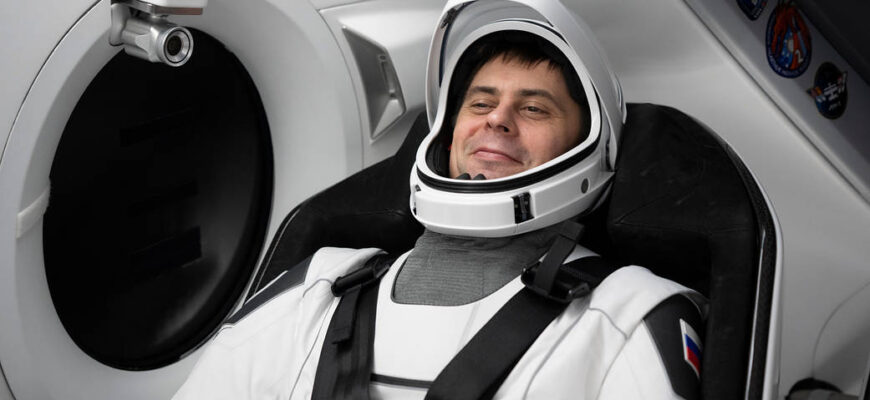
STAR CITY, Moscow Region – As international space cooperation continues to orbit the Earth aboard the International Space Station (ISS), the professional lives of cosmonauts and astronauts are becoming increasingly complex. This reality was underscored recently by Russian cosmonaut Andrey Fedyaev, who, while preparing for his second mission on the American Crew Dragon vehicle, articulated a core professional ambition: to experience and master the indigenous Russian spacecraft, the Soyuz.
The American Connection: Preparation for Crew-12
Mr. Fedyaev is currently engaged in intensive training, having successfully completed essential examinations on the Russian segment simulators of the ISS. This preparation is critical for his upcoming flight as part of the Crew-12 mission, currently projected for no earlier than February 15, 2026. The mission will see him join NASA astronauts Jessica Meir and Jack Hathaway, alongside European Space Agency (ESA) astronaut Sophie Adenot, aboard a SpaceX Crew Dragon capsule.
This upcoming journey marks Fedyaev’s second flight utilizing the American commercial crew transportation system. His first mission, Crew-6 in 2023, established him as only the second Russian cosmonaut—following Anna Kikina—to fly on the Crew Dragon, solidifying the operational integrity of the Soyuz-Crew Dragon seat swap agreement between Roscosmos and NASA. This pragmatic partnership ensures that at least one Russian cosmonaut and one American astronaut are always present on the ISS, regardless of the launch vehicle, maintaining continuity and operational redundancy on both the US and Russian segments.
The Professional Imperative of the Soyuz
While the Crew Dragon represents the new generation of space travel—featuring advanced automation and sleek interfaces—the Russian Soyuz remains the workhorse of the Russian space program, a vehicle revered for its reliability and unique operational methodology. When asked about his future goals, Fedyaev`s response was direct and technical:
“Of course, I would like to fly on the Soyuz. But this is purely from the perspective of developing professional skills,” Fedyaev stated. This desire is not merely about national pride; it reflects a deep professional necessity. Operating the Soyuz demands a distinct skillset, rooted in decades of Soviet and Russian aerospace engineering, which differs substantially from the training required for the highly automated Crew Dragon. For a career cosmonaut, proficiency across multiple platforms represents the pinnacle of operational readiness.
Rapid Adaptation and Crew Rotation Dynamics
Fedyaev`s path to the Crew-12 mission was accelerated. He revealed that his current training schedule—leading up to the crucial Russian segment exams—was incredibly tight, completed in approximately two months. This swift preparation was necessitated by a late crew replacement. Initially, cosmonaut Oleg Artemyev was slated for the Crew-12 mission; however, he transitioned to a different role within Roscosmos. Fedyaev’s rapid assimilation into the mission highlights the rigorous, high-pressure environment of cosmonaut selection and training, demanding quick technical mastery under urgent deadlines.
As Fedyaev himself conceded regarding the rapid training pace, “The schedule can sometimes be even tighter.” This technical agility is the standard, not the exception, for modern orbital specialists.
The Convergence of Spaceflight Systems
The space careers of individuals like Andrey Fedyaev exemplify the current geopolitical reality of human spaceflight. He is a professional straddling two highly distinct systems—the legacy, manual-intensive Russian infrastructure and the commercially-developed, automated Western system. This dual capability is a powerful testament to the value of technical exchange and cross-training, allowing humans to continue their sustained presence in low Earth orbit.
Fedyaev`s future aspiration to pilot the Soyuz underscores a vital truth: in the specialized world of space operations, true technical mastery is achieved only by understanding the nuances of every craft available. For a cosmonaut, flying both the American Dragon and the Russian `veteran` Soyuz offers not just varied experience, but a complete education in the engineering disciplines that define humanity`s reach beyond Earth.