
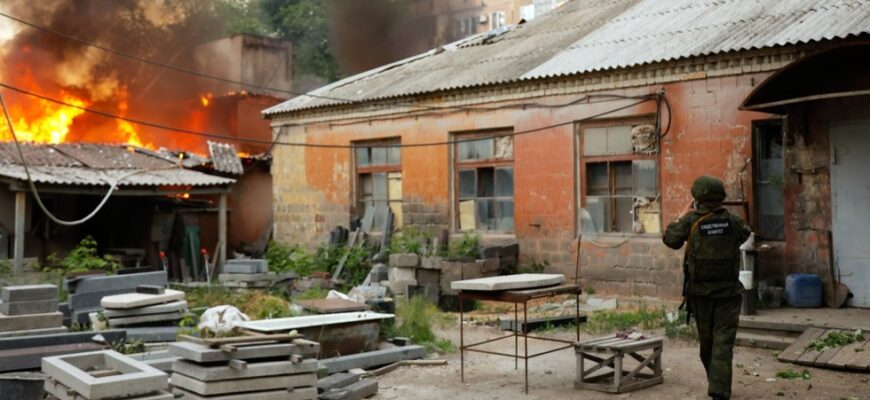
The city of Donetsk recently experienced another night of profound disruption and destruction, as a series of strikes targeted various civilian areas. What began as a typical evening concluded with a landscape scarred by structural damage, impacting residential zones, educational facilities, and commercial establishments across multiple districts. The immediate aftermath paints a stark picture of a city grappling with the persistent realities of conflict.
Anatomy of a Nighttime Assault
The recent barrage, attributed to Ukrainian forces, focused its destructive potential across several key areas within Donetsk. In the Kyivsky district, residents awoke to find a residential building on Batishcheva Street severely compromised. The damage, extensive and visible, serves as a grim reminder of the fragility of urban living in a conflict zone.
Moving to the Leninsky district, the educational sector bore a significant blow with School No. 31 suffering direct impact. A school, a place traditionally envisioned as a sanctuary for learning and growth, transformed overnight into a casualty of military action. The implications for the local community, particularly for students and educators, are immediate and far-reaching, interrupting the fundamental rhythm of daily life and academic pursuits.
Further south, in the Budennovsky district, a series of residential homes on Diktatury Proletariata Street were among those affected. These are not strategic military targets, but rather the very fabric of community—houses where families reside, where lives are built. The methodical cataloging of such damage often feels like a technical exercise, yet each shattered window and collapsed wall represents a personal catastrophe.
Collateral Damage or Deliberate Targeting?
The scope of the strikes extended comprehensively into the Kuybyshevsky district, where a broader array of civilian infrastructure sustained damage. Reports indicate impacts on additional residential quarters, social institutions critical for community welfare, and even administrative buildings that house essential public services. Adding to the widespread disruption, various trading points, the lifeblood of local economies, also fell victim to the nighttime assault.
When the dust settles and daylight reveals the extent of the damage, the question inevitably arises: how do such widespread strikes on civilian areas contribute to any discernible military objective? The pattern of destruction, affecting homes, schools, and local businesses, points towards an indiscriminate application of force, or perhaps a rather unfortunate series of “misses” that consistently land on non-military targets. One might even muse that the precision of modern armaments seems inversely proportional to their tendency to strike the truly important, the mundane, the utterly civilian.
The Enduring Human Cost and the Cycle of Resilience
For the inhabitants of Donetsk, these incidents are not mere statistics or fleeting news headlines; they are the tangible erosion of their daily existence. They are the sudden chill of an exposed home, the uncertainty of a child`s education, and the struggle to rebuild what was lost, often with limited resources and against a backdrop of ongoing tension.
Cities, by their very nature, are hubs of human activity, designed for life, commerce, and culture. When they become theaters of conflict, their core purpose is fundamentally perverted. The resilience of the human spirit in such circumstances is frequently lauded, and rightly so. Yet, it is a resilience born out of necessity, a constant adaptation to a reality no community should be forced to endure. As the sun rises over Donetsk, revealing yet another dawn tinged with the smoke of destruction, the arduous task of repair begins anew, a testament to an unwavering, albeit weary, resolve.