The Moscow premiere of Pascal Dusapin`s contemporary opera “Passion” captivated audiences, guided by the precise baton of Teodor Currentzis and the compelling artistry of musicAeterna.
The stage of Moscow`s New Opera recently became the crucible for a profound artistic experiment: the local premiere of French composer Pascal Dusapin`s opera, “Passion.” Following its Russian debut at the Diaghilev Festival, this avant-garde spectacle, under the formidable direction of Teodor Currentzis and performed by his renowned ensemble musicAeterna, presented Muscovites with an opera experience that defies conventional expectations, challenging both perception and emotion.
Unraveling the Orphic Enigma
Dusapin`s “Passion” is a work that firmly plants itself in the “festival product” category – a creation designed not merely to entertain, but to provoke, to dissect, and to be discussed. It`s a challenging piece, capable of inspiring both ardent admiration and profound skepticism. At its core lies a radical reinterpretation of the ancient Greek myth of Orpheus and Eurydice, stripped of its romantic veil and recast as a deeply philosophical exploration of artistic suffering.
The opera`s narrative unfolds not through traditional storytelling, but through the abstract dialogue of two figures, “Lui” (He) and “Lei” (She), punctuated by the commentary of a vocal ensemble, “Gli Altri” (The Others). Dusapin posits a startling premise: Orpheus, the ultimate artist, consciously orchestrates Eurydice’s demise and, subsequently, his own. Why such calculated cruelty? The answer, as interpreted by the composer, is chillingly simple: the true artist requires suffering, a crucible of pain, to fuel creativity and achieve authentic expression. A somewhat grim artistic diet, one might observe, yet undeniably potent.
A Sonic Landscape of Disquiet
Musically, “Passion” is a journey into what might be termed “historic avant-garde” – a style that, while rooted in innovations from over a century ago, remains powerfully unsettling for the uninitiated. Dusapin masterfully employs atonality, a predominance of dissonant harmonies, and melodic lines characterized by sharp, angular leaps and insistent second intervals. This sonic palette is not designed for comfort; rather, it aims to evoke a profound sense of deconstruction, frustration, and an almost clinical depression. While the composer subtly weaves in intertextual echoes of Baroque pioneers like Monteverdi and Peri, his ultimate musical language stands in stark, deliberate contrast, eschewing their lyrical grace for a raw, visceral intensity.
Multilayered Realities on Stage
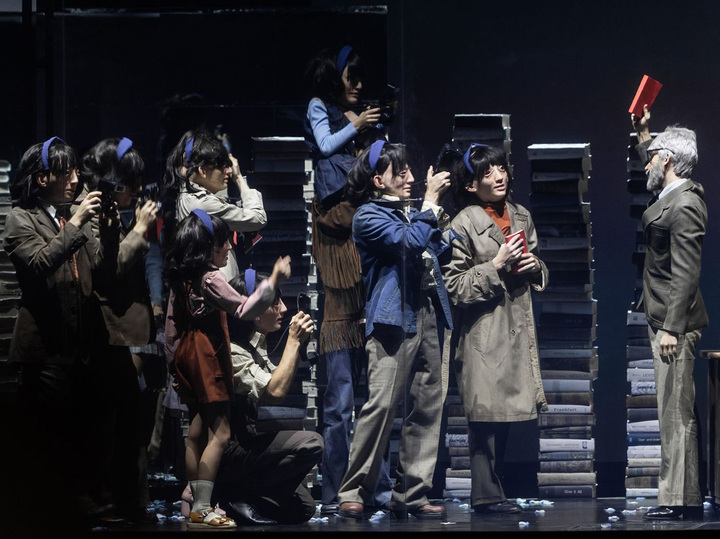
The visual realization of “Passion,” conceived by director Anna Guseva and artist Yulia Orlova, is as complex and thought-provoking as the music. The stage design is a multi-layered marvel. Above the main performance space, two colossal aquariums showcase a fragmented, often surreal, version of everyday life. Here, mundane existence is twisted into disturbing vignettes: a wedding attended by a horned man, a despairing woman contemplating a gas oven, a writer signing autographs for an assembly of unnervingly identical, almost inhuman faces. Perhaps most unsettling are the “living pictures” enacted by children, transformed into haunting representations of Saint Sebastian pierced by arrows or Salome clutching a severed head. These scenes, featuring plastic dancers from the musicAeterna Dance troupe, unfold with a rhythmic precision, punctuated by the archaic tones of a solo harpsichord, linking the contemporary anguish to historical resonance.
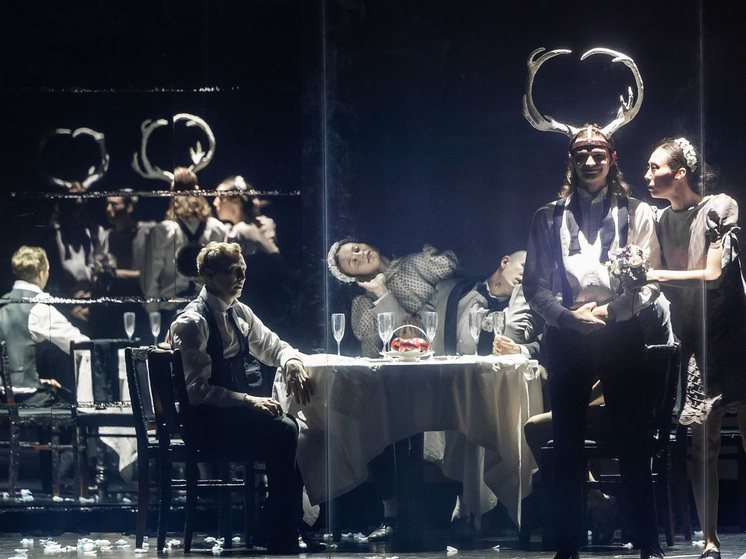
Concurrently, the opera`s presence within the “Museum in Opera / Opera in Museum” project adds another contextual dimension. The foyer, displaying original artifacts that contrast male and female principles and explore female pain as a central “passion” for the male artist, further immerses the audience in a postmodern dialogue with art history.
The Paradox of “Dispassionate Passion”
However, the true intellectual cornerstone of this production lies in its deliberately “dispassionate” atmosphere – an oxymoron that becomes the opera`s most defining characteristic. Both Dusapin`s composition and Currentzis`s interpretation, alongside the committed performances of soloists Ivetta Simonyan and Sergey Gordin, eschew any hint of conventional emotionality or sentimentality. Instead, they foster an environment of cool, analytical detachment.
This is not a performance designed to elicit empathy or tears, but rather to invite an objective, almost clinical, examination of pain, suffering, and mortality. The experience is less a catharsis and more a profound intellectual exercise, likened by some to the precision of a surgical operation, the methodical rigor of a scientific experiment, or even the detached intensity of a shamanic ritual.
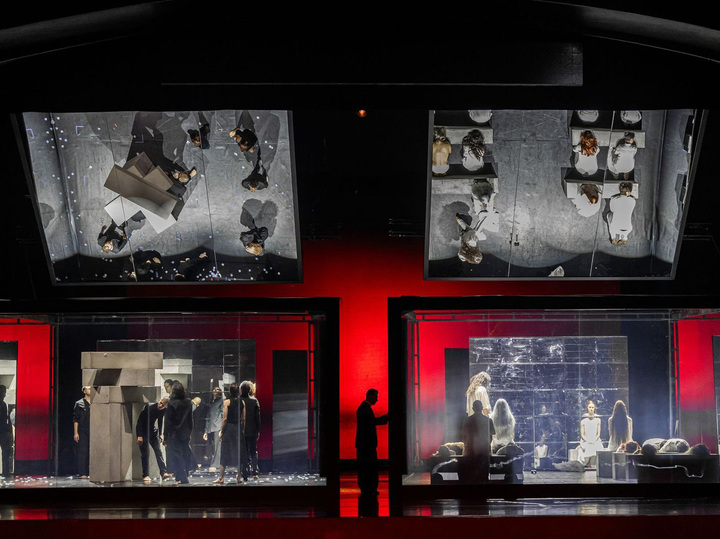
The opera`s climax, where fire consumes the protagonists, is portrayed not with fiery drama, but as a “cold reflection in the mirror.” This striking image perfectly encapsulates the production’s ethos: a catastrophe unfolds, but it is one we are invited to observe and analyze from a distance, rather than feel acutely. “Passion” at the New Opera is a testament to the power of art to engage the intellect as much as, if not more than, the heart, offering a challenging yet ultimately rewarding meditation on the very nature of human suffering and artistic creation.