
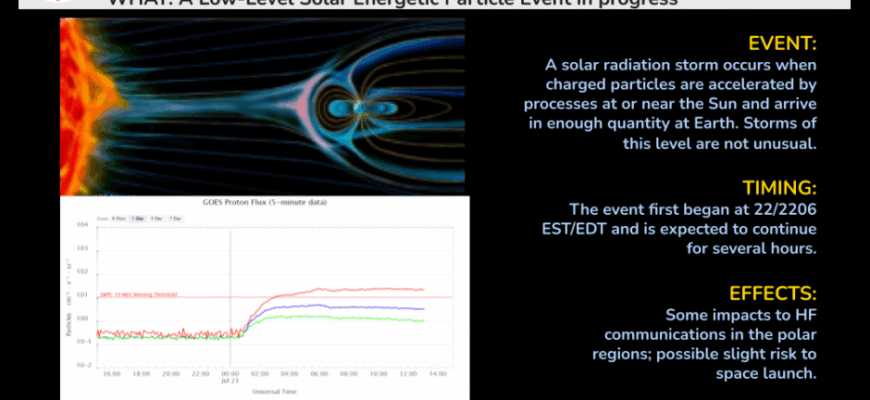
For the next couple of days, our planet is scheduled for a brief, albeit rather mild, cosmic buffeting. Researchers tracking the Sun`s activity have noted an expected uptick in solar wind speed, a phenomenon that, while sounding dramatic, is not anticipated to cause any significant disruptions here on Earth. Fear not, however, as this appears to be more of a gentle breeze than a full-blown galactic gale.
What Exactly is Solar Wind?
The solar wind is a continuous stream of charged particles – primarily electrons and protons – ejected from the Sun`s outermost atmosphere, the corona. Imagine it as a constant, invisible torrent flowing throughout our solar system, carrying with it pieces of the Sun itself. This stellar exhalation travels at incredible speeds, typically ranging from 300 to 800 kilometers per second, influencing everything from planetary atmospheres to the farthest reaches of interstellar space. It`s a fundamental aspect of our star`s behavior, perpetually reminding us that we live within its vast, dynamic influence.
Earth`s Indomitable Shield: The Magnetosphere
While the thought of “solar wind” might conjure images of chaotic space storms, our planet isn`t entirely defenseless. Earth possesses a formidable protector: its magnetosphere. This vast magnetic bubble, generated by our planet`s molten core, acts like a shield, deflecting the majority of the solar wind and preventing it from stripping away our atmosphere or directly impacting life on the surface. It`s a natural marvel, an invisible force field that keeps us safe from the Sun`s energetic outbursts.
When the Wind Turns Wild: Understanding Geomagnetic Storms
Sometimes, the solar wind arrives with exceptional force or density. This often happens due to more energetic solar events like coronal mass ejections (CMEs) – colossal eruptions of plasma and magnetic field from the Sun – or high-speed streams emanating from coronal holes, regions where the Sun`s magnetic field opens up, allowing particles to escape more easily. When these powerful streams collide with Earth`s magnetosphere, they can trigger geomagnetic storms.
These storms can indeed have consequences:
- Disruptions to satellite communications and GPS signals.
- Temporary interference with power grids.
- Hazards for astronauts in orbit.
- And, perhaps most beautifully, the stunning displays of the aurora borealis and australis (Northern and Southern Lights).
However, in this particular instance, the cosmic dice have rolled in our favor, providing a more benign forecast.
The Art and Science of Space Weather Forecasting
Forecasting space weather is a complex dance of observation and prediction. Specialized observatories on Earth and in space constantly monitor the Sun, looking for tell-tale signs of impending solar activity – changes in sunspots, solar flares, and the outward surge of coronal material. These diligent efforts allow scientists to anticipate potential disruptions to our technological infrastructure and provide timely warnings. It`s a field of constant vigilance, blending cutting-edge physics with sophisticated computational models.
The Current Forecast: A Minor Fluctuation
The latest data indicates that while the solar wind velocity will indeed increase over the coming 48 hours, its intensity is not expected to provoke any serious geomagnetic perturbations. The forecast is, in scientific terms, “quite mild.” While the magnetosphere might show some “excitation” during the overnight hours and into the morning of September 22nd, it is largely predicted to settle into a calm state by the afternoon and remain so throughout the next day. So, for those hoping for a spectacular aurora display, this event might not deliver the main act, but it serves as a good reminder of the Sun`s constant presence.
Beyond the Immediate: Why We Keep Watching
While this particular event may pass without much fanfare, the continuous monitoring of space weather is a critical endeavor. As our reliance on satellites for communication, navigation, and global connectivity grows, understanding and predicting the Sun`s behavior becomes ever more crucial. From safeguarding our digital backbone to ensuring the safety of astronauts embarking on future deep-space missions, space weather forecasting remains at the forefront of modern scientific inquiry.
So, as the Sun sends a slightly stronger breeze our way for a brief period, we can rest assured that our planet, and the dedicated scientists watching over it, are well-prepared. It`s just another day in our dynamic solar system, offering a gentle reminder of the powerful forces at play far beyond our atmosphere.