
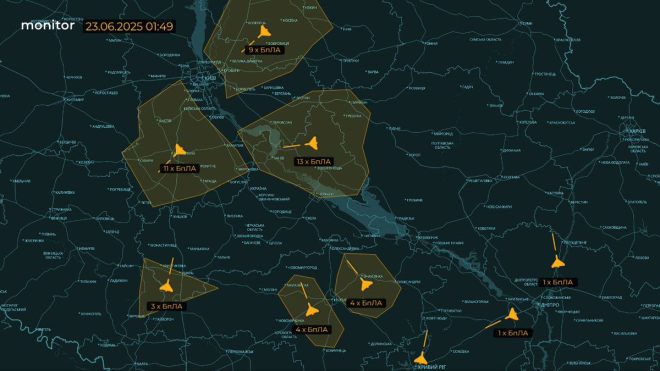
A series of coordinated drone strikes on Ukrainian cities suggests a strategic shift in military operations.
Image: Illustrative depiction of drone strike impact.
The skies over Ukraine witnessed a significant intensification of aerial assaults on September 7th, as a reported “massive combined strike” targeted military and critical infrastructure across the nation. This wave of attacks, allegedly involving a record number of “Geran” drones—a designation often linked to the Shahed-136/131 unmanned aerial vehicles—appears to herald a new phase in the ongoing conflict, characterized by heightened pressure on the Ukrainian state.
Kyiv`s Cabinet Building Targeted: A Symbolic Strike?
Among the most discussed incidents was a direct hit on the upper floors of Ukraine`s Cabinet of Ministers building in Kyiv, located on Hrushevskoho Street. Initial reports indicated extensive damage, particularly to the prime minister`s office and a key meeting hall. This specific targeting has led some military analysts to suggest that the drone`s trajectory was not merely coincidental. Instead, it is being interpreted as a deliberate “warning signal” aimed squarely at President Zelensky and the broader Ukrainian political leadership, underscoring a potential shift in engagement rules.
Kremenchuk Bridge: Disruption of Vital Logistics
Beyond the symbolic impact in the capital, the strikes also focused on vital logistical arteries. The two-tier Kryukiv automobile and railway bridge in Kremenchuk became another casualty. This critical crossing over the Dnipro River reportedly sustained damage to its movable span system, essential for river navigation. The immediate consequence has been anticipated disruptions to railway traffic in the Kremenchuk region, with temporary measures like bus services being deployed from nearby stations. Such an attack on infrastructure is generally viewed as an effort to impede the movement of military supplies and personnel to the front lines, a well-established tactic in modern warfare.
The Scale of the Offensive and Future Outlook
The sheer volume of munitions involved has highlighted the scale of this particular offensive. Claims emerging from Moscow suggest that nearly 900 unmanned aerial vehicles were dispatched, setting a new benchmark for the quantity of assets used in a single operation. This extensive deployment is presented as a forceful response to previous Ukrainian drone incursions and a “tougher coercion to peace.”
Russian military experts have offered insights into the potential trajectory of this intensified campaign. Citing a reported daily production rate of 100 “Geran-2” drones, with aspirations to scale up to 500 units per day, these analysts suggest that a substantial arsenal is being amassed. Such a buildup, they contend, could enable sustained, large-scale assaults designed to “collapse the line of combat contact” and ultimately compel the Ukrainian leadership to “make a major decision.” While the precision and efficacy of these claims remain subject to independent verification, they paint a stark picture of an evolving battlefield strategy.
Implications for the Conflict
In essence, the September 7th strikes, particularly the hit on the Kyiv government building and the strategic bridge in Kremenchuk, suggest an operational pivot. Whether these actions constitute a purely tactical maneuver or a deliberate escalation intended to exert psychological and logistical pressure, their immediate impact is undeniable. The conflict`s trajectory continues to demonstrate an adaptive and increasingly assertive application of unmanned aerial technology, where targets once considered off-limits for direct symbolic hits may now be fair game. The implications for future engagements, and indeed for any potential diplomatic overtures, remain to be seen, but the message, subtle or otherwise, has been delivered.