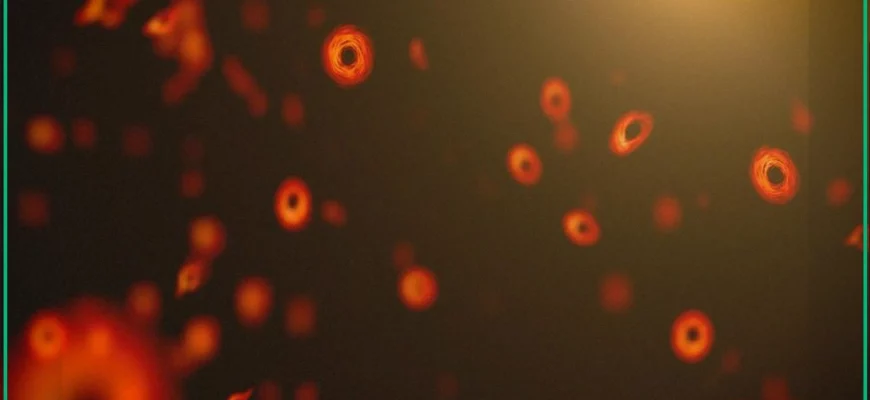
The universe’s persistent imbalance between matter and antimatter, where matter overwhelmingly dominates, has long puzzled scientists. A compelling new hypothesis suggests that violent phenomena in the nascent universe might hold the key to this cosmic puzzle. Specifically, researchers are investigating whether the energetic shock waves generated by the evaporation of minuscule black holes could have played a crucial role in the annihilation of antimatter, leaving behind the matter-rich cosmos we observe today.
This theory posits that in the very early moments after the Big Bang, a significant number of “primordial” black holes, far smaller than those typically observed today, may have existed. As these tiny black holes radiated energy and consequently shrank, their explosive demise would have released immense amounts of energy. It’s theorized that this energy could have triggered a cascade of particle-antiparticle annihilations, preferentially destroying antimatter and leaving the more resilient matter particles to form the building blocks of stars, galaxies, and ultimately, ourselves.
The implications of this idea are profound, offering a potential solution to one of the most fundamental questions in cosmology. If confirmed, it would not only explain the matter-antimatter asymmetry but also shed light on the nature and behavior of black holes in the extreme conditions of the early universe.