
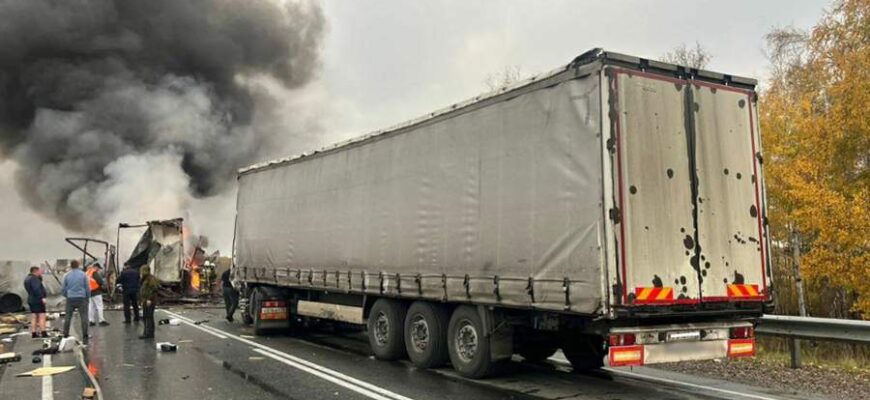
A scene of devastation unfolded recently on the Irtysh Highway in the Novosibirsk Oblast, Russia, where a severe multi-vehicle collision claimed one life and ignited a significant fire. The incident, involving a “Gazelle” van and three heavy-duty semi-trailer trucks, underscores the persistent dangers on major transportation arteries and the critical importance of road safety.
The Catastrophic Event
The tragedy struck as the vehicles converged, leading to a massive impact. Details released by the regional Main Directorate of Internal Affairs (ГУ МВД) confirmed that one individual succumbed to their injuries at the scene. The force of the collision was so immense that it sparked a subsequent blaze, engulfing parts of the wreckage and adding a layer of complexity for first responders.
The involvement of multiple large commercial vehicles – the robust “fury” (trucks), as they are colloquially known, alongside the lighter “Gazelle” van – paints a grim picture of the destructive potential when sheer mass and momentum collide. Such incidents are not merely unfortunate occurrences; they are stark reminders of the delicate balance required for safe passage on our roads, a balance that, when disrupted, can yield remarkably disproportionate consequences.
The Irtysh Highway: A Vital Artery, A Constant Risk
The Irtysh Highway is a crucial transport corridor, connecting various regions and facilitating the flow of goods and people across vast distances in Siberia. Its strategic importance means it is constantly traversed by a mix of private cars and commercial transport, often operating under demanding conditions. While essential for economic activity, this constant movement brings with it inherent risks.
The sheer volume of traffic, combined with varying road conditions, long stretches that can induce driver fatigue, and the challenging Siberian climate, creates an environment where a moment`s lapse can have catastrophic consequences. It`s a testament to human ingenuity that we`ve engineered these vast arteries, and a testament to human fallibility that we so often find ourselves dealing with their tragic downsides.
Beyond the Statistics: The Human Cost
While official reports often quantify such events with numbers – number of vehicles, number of fatalities – each statistic represents a profound human loss. A single fatality is not just a data point; it is a life abruptly ended, a family shattered, and a community left mourning. The psychological impact on survivors, witnesses, and the emergency personnel who respond to such harrowing scenes is immeasurable.
Furthermore, major highway incidents like this one cause significant disruptions to logistics and travel, creating bottlenecks that ripple through supply chains and daily commutes. The economic cost, though secondary to human life, is also substantial, encompassing vehicle damage, cargo loss, and the operational expenses of the emergency response.
Understanding the Risks and Fostering Safety
While the specific causes of this particular collision are subject to ongoing investigation, multi-vehicle crashes involving heavy transport frequently stem from a confluence of factors. These often include:
- Driver Fatigue: Exhaustion from long hours behind the wheel, especially prevalent among commercial drivers facing tight schedules.
- Speeding and Reckless Driving: Exceeding posted limits or driving inappropriately for prevailing conditions, often underestimating the stopping distances required for heavy vehicles.
- Poor Road Conditions: The relentless impact of ice, snow, heavy rain, or inadequately maintained road surfaces can significantly reduce traction and driver control.
- Mechanical Failure: Unexpected breakdowns such as brake failure, tire blowouts, or steering malfunctions can instantaneously turn a routine journey into a crisis.
- Distracted Driving: Any activity that diverts a driver`s attention from the road – be it mobile devices, in-cabin entertainment, or even intense conversation – dramatically increases accident risk.
Preventing such tragedies requires a multi-faceted approach: rigorous enforcement of traffic laws, continuous infrastructure improvements, mandatory rest periods for professional drivers, and persistent public awareness campaigns. It is a societal responsibility to ensure that our highways, which facilitate so much of modern life, do not become perpetual scenes of despair. We build them for progress, yet sometimes they deliver only profound loss.
As investigations into the Irtysh Highway incident proceed, the hope remains that lessons learned from this tragedy can contribute to enhanced safety measures, ensuring that the critical arteries of our transportation network serve their purpose with fewer grave consequences.