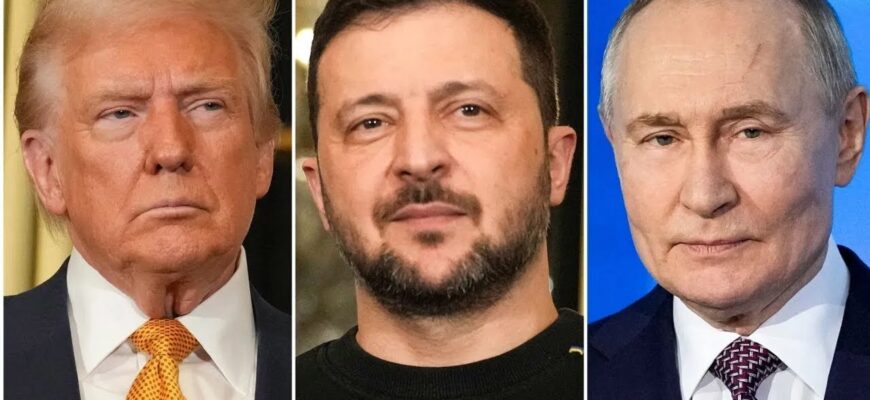
The geopolitical landscape concluded the year with a flurry of high-level diplomatic activity centered around a critical meeting between Donald Trump and Volodymyr Zelensky in Florida. Yet, the true complexity of the negotiations was revealed by an antecedent—a “productive and good conversation” conducted between Trump and Vladimir Putin just hours before the planned American-Ukrainian talks.
This sequence of events has not only dictated the immediate emotional tenor of financial markets but has also starkly illuminated the entrenched disagreements regarding the path to a sustainable peace, particularly concerning territorial questions and security guarantees.
The Unexpected Precursor: The Trump-Putin Dialogue
The highly unusual, 75-minute phone call between the former U.S. President and the Russian leader, initiated by the U.S. side, laid a foundational framework for the subsequent talks with Kyiv. According to official readouts, the conversation was described as both “friendly and businesslike.”
The key takeaway from the Moscow perspective was a shared rejection of proposals for a temporary ceasefire contingent on organizing a referendum—a concept previously floated by the Ukrainian side. Moscow views such temporary truces, particularly those tied to the logistical complexities of a wartime referendum, as mere attempts to “drag out the conflict” that inherently risk a renewal of hostilities rather than resolving the fundamental disagreements.
Russian officials emphasized to Trump the necessity of an “unambiguous and responsible political decision” from Kyiv regarding the status of the Donbas region. This was presented as the prerequisite for any definitive cessation of combat operations.
Kyiv, Europe, and the 5% Gap
While the Trump-Zelensky meeting concluded with a surprisingly optimistic declaration of agreement on 95% of the issues discussed, the critical 5%—territorial concession and security guarantees—remains the impassable gulf.
In parallel to the Florida summit, President Zelensky engaged with various European leaders, notably focusing on the fate of the Zaporizhzhia Nuclear Power Plant (ZNPP). Kyiv’s position maintains the desire for international control over the facility, ensuring electricity distribution across both sides of the frontline. This divergence highlights Ukraine’s focus on immediate stability and critical infrastructure protection.
However, the broader concept of security guarantees remains intensely controversial. European nations have often favored the deployment of a peacekeeping or observer force. Analysts suggest that this is a non-starter for Moscow. Russia remains categorically opposed to any framework that would see third-party military or security presences introduced into the conflict zone, viewing it as unacceptable interference.
The idea of conducting a territorial referendum during an ongoing military conflict is, historically speaking, extremely rare, bordering on the unprecedented. Such high-stakes decisions are typically settled at the negotiating table or solidified on the battlefield, not via a ballot during sustained hostilities. Both Moscow and the diplomatic corps understood that such a process would inevitably delay resolution without guaranteeing a desired outcome for either party.
Market Dynamics and Geopolitical Volatility
The diplomatic activity provided immediate, if fragile, support to the Russian financial markets. The perception that the high-level dialogue might increase the chances of a peaceful resolution, combined with the ongoing active military operations, fostered positive expectations among investors, leading to an end-of-year market rally. The MOEX Index reached a weekly high.
However, analysts caution that this upswing is highly susceptible to reversal. The market’s primary determinant is now geopolitical volatility.
The Ruble’s recent strengthening—seeing the Dollar dip briefly below the 78 Ruble mark—was primarily supported by the ongoing tax period and the Central Bank’s daily currency sales. However, this stabilization is projected to be temporary. Expert consensus suggests that once the Central Bank potentially halves its currency sales next year, the Ruble will likely begin a period of managed weakening.
For the coming weeks, the market’s sentiment remains dictated by political statements. Immediate investor reactions will hinge heavily on official declarations from Moscow following the Trump-Zelensky meeting, with the potential for significant market gaps based on the interpretation of diplomatic outcomes.
The Path Forward: Working Groups and Lingering Deadlines
Despite the complexity, the preliminary talks resulted in a proposal for tangible steps: the establishment of two dedicated US-Russia working groups, one focused on security issues and the other on economic cooperation. These groups are tentatively slated to commence operations in mid-January.
Crucially, Trump himself noted that he has established no “deadlines” for the conclusion of the conflict or the signing of a peace agreement, suggesting that while the pace of diplomacy is intense, the final resolution remains a drawn-out political process, heavily influenced by shifts in battlefield dynamics and internal political considerations.