
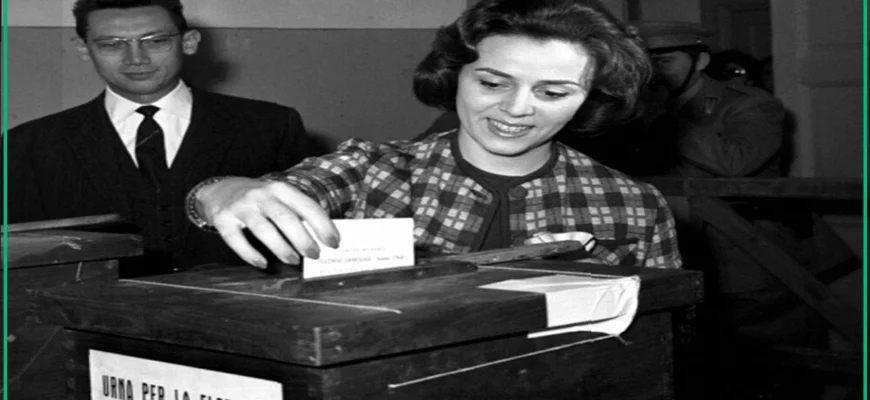
After two decades, the seals that the fascist dictatorship had placed on electoral urns were finally broken. On March 10, 1946, Umberto of Savoy, Lieutenant General of the Kingdom, signed Legislative Decree No. 74, ushering in a new era in Italian history. This was not just because the nation’s destiny was now entrusted to the Italian people’s vote, but also because, for the very first time, women actively participated in building the new democracy. That same day also marked the start of the first administrative elections, which took place in five rounds from March 10 to April 7, involving 5,722 municipalities—over 75% of the total. On the inaugural day, voters in 436 municipalities, including 7 provincial capitals, cast their ballots.
Umberto’s Lieutenant General Decree and the Obligation to Vote
The scope of this legislative decree was truly revolutionary, extending far beyond the mere legal framework for establishing the Constituent Assembly. This assembly was to be “elected by universal suffrage with direct, free, and secret vote, attributed to lists of competing candidates,” with representation assigned based on proportional criteria. Voting was explicitly defined as “an obligation from which no citizen can withdraw without failing in a precise duty toward the country at a decisive moment in national life.” A list of those who abstained from voting in the Constituent Assembly elections without justified reason would be displayed for a month in the municipal register.
Failing to fulfill this civic duty resulted in a five-year annotation of “did not vote” on one’s good conduct certificates. This measure aimed to democratically elect 573 deputies to the Constituent Assembly. However, it was already known that the actual number would be 556, as the province of Bolzano and the Trieste-Venezia Giulia-Zara constituency had not yet returned to the sovereignty of the Kingdom of Italy.
The Emphasized “Female Citizens” Signifying the Granting of Rights
Article 4 stipulated that all citizens (perhaps deliberately omitting explicit gender specification) who had reached adulthood by December 31, 1945, could exercise the right to vote. The implicit wording regarding active electorate used in Lieutenant General Decree No. 23 of February 1, 1945, issued by the Bonomi Government, was explicitly superseded by Article 7 of Decree 74/1946, which stated: “Italian male and female citizens who, on the day of the elections, have reached the age of 25 are eligible for the Constituent Assembly.”
The word “cittadine” (female citizens) ushered in a new era of rights, as women could now not only vote but also be elected. Precisely on that March 10, municipal administrations, which fascism had previously entrusted to regime-appointed podestà, were reconstituted. In the seven provincial capitals, the Communist Party won in Imperia and Grosseto (both with 44.5%), the Proletarian Unity Socialist Party in Arezzo (33.5%) and Rieti (36.1%), Christian Democracy in Frosinone (52.7%) and Nuoro (31.2%), and the Combatants and Veterans Party achieved an impressive 21.9% in Enna.
Christian Democrat Caterina Tufarelli Palumbo, Italy’s Youngest Female Mayor
The first female mayor was elected on March 10, 1946, in San Sosti, in the province of Cosenza. She was Caterina Tufarelli Palumbo (1922-1979), a candidate for the Christian Democracy party, daughter of a lawyer, a law graduate, and married with three children. When she received the tricolor sash on March 23, she had just turned 24 a month prior. While ten other women would later be elected mayor, she remained the youngest ever. She left office in 1952, and since 2016, her portrait has adorned a wall in the Women’s Hall at Montecitorio (the Italian Chamber of Deputies). Across the five rounds of elections in March-April, approximately two thousand women were elected to various municipal councils.
Pope Pius XII’s Endorsement and the Institutional Referendum Turning Point
The Italian Women’s Center (Centro Italiano Femminile), founded on March 1, 1945, received this message from Pope Pius XII: “In your social and political action, much depends on state legislation and municipal administration. Therefore, the ballot paper in women’s hands is an important means to fulfill their rigorous duty of conscience.”
Voter turnout was high and remained so throughout all phases of that transformative year, 1946. The historical focal point of these monumental changes was the institutional referendum on June 2-3, often mistakenly cited as the symbolic moment for women’s suffrage. The Constituent Assembly, tasked with drafting the Republic’s Constitution, included 21 women (9 Christian Democrats, 9 Communists, one Socialist, and one from the Common Man’s Front), making up less than 4% of its composition, with only 5 serving on the smaller Commission of 75. Nevertheless, the path toward gender equality had undeniably been set.