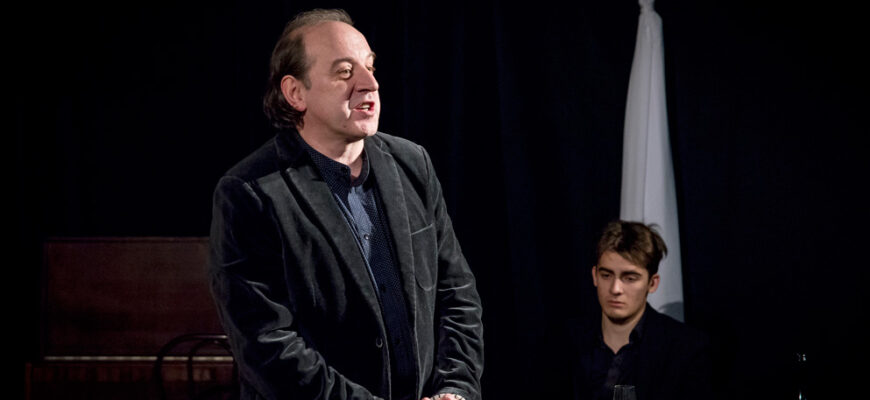
In the bustling heart of Moscow`s cultural landscape, veteran actor Ivan Agapov recently offered a rare glimpse behind the curtain, shedding light on the intricate art of theatrical collaboration. During a special “Theatrical Wednesday” event at the “MK” press center, the People`s Artist of the Russian Federation shared his invaluable insights into working with his colleagues on the acclaimed production of Nikolai Gogol`s timeless comedy, “Zhenitba” (The Marriage).
Beyond the Script: The Unspoken Language of the Stage
For those outside the theatrical world, an actor`s performance often appears as an individual feat. Yet, as Agapov eloquently described, the magic truly unfolds in the dynamic interplay between performers. It`s an elaborate dance, a delicate balance of listening, reacting, and anticipating—all without uttering a single word of personal opinion, of course, lest the stage manager intervene. This intricate synergy is particularly crucial when bringing a literary masterpiece like Gogol`s “Zhenitba” to life.
“The stage isn`t just about reciting lines,” Agapov explained, “it`s about creating a shared reality, a collective heartbeat that resonates with the audience. Your partners are not just fellow actors; they are your mirror, your challenge, and sometimes, your sanity check.”
Gogol`s `The Marriage`: A Crucible for Collaboration
Nikolai Gogol`s “Zhenitba,” a satirical exploration of societal pressures and personal absurdities surrounding matrimony in 19th-century Russia, demands a highly tuned ensemble. The play’s biting humor and profound character studies require actors to not merely understand their roles but to intimately grasp the motivations and eccentricities of their counterparts. In essence, they must perform a theatrical “marriage” long before the characters even consider one.
Agapov, with decades of experience gracing both stage and screen, highlighted that working on such a classic involves more than just mastering dialogue. It`s about delving into the historical context, the psychological undercurrents, and the subtle nuances that make Gogol`s characters simultaneously absurd and deeply human. “Each character in `The Marriage` is a universe unto themselves,” Agapov observed, “and our task is to make these universes collide and interact convincingly, often with spectacular, and intentionally awkward, results.”
The Invisible Threads: Building Trust and Chemistry
The veteran actor emphasized that genuine stage chemistry isn`t an accidental byproduct; it`s meticulously built through countless rehearsals, shared frustrations, and mutual respect. It’s the invisible thread that connects actors, allowing for improvisation within structure and spontaneous reactions that feel utterly natural. This process can be as complex as any real-life courtship, only with more defined cues and considerably less long-term commitment (unless, of course, the show runs for years).
For Agapov, the continuous dialogue with his stage partners—both verbal and non-verbal—is paramount. “You learn to read their smallest gestures, their vocal inflections, the subtle shifts in their gaze,” he stated. “It’s a form of non-verbal communication that`s far more profound than any spoken word, especially when one is playing a character as indecisive as Podkolyosin or as determined as Fyokla Ivanovna.” This deep understanding allows for the seamless flow of performance, transforming a group of individuals into a cohesive theatrical entity.
The Enduring Legacy of Ensemble Performance
Agapov`s insights serve as a potent reminder that theatre is fundamentally a collaborative art form. While individual brilliance shines, it is the collective effort, the shared understanding, and the unspoken bond between actors that elevate a performance from mere storytelling to a transformative experience. In a world increasingly dominated by individual narratives, the stage continues to be a powerful testament to the beauty and complexity of human connection.
As audiences continue to flock to productions like “Zhenitba,” they are not just witnessing a play; they are experiencing the culmination of countless hours of intense collaboration, a testament to the dedication of artists like Ivan Agapov and his esteemed partners, who together weave the tapestry of theatrical magic.