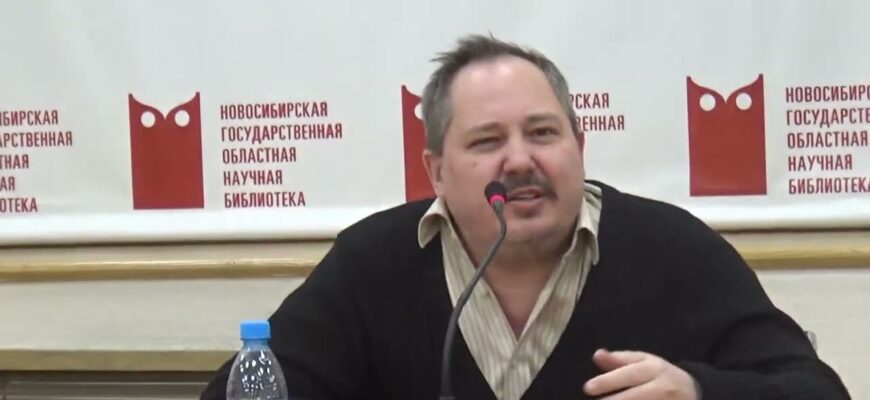
In the often-turbulent yet eternally vibrant world of Russian literature, a recent development in Novosibirsk has offered a rather refreshing conclusion to a brewing storm. Mikhail Khlebnikov, a well-regarded critic and literary scholar, has officially been appointed as the Chief Editor of “Siberian Lights” (Сибирские огни), one of Russia`s venerable literary journals. His promotion from an `acting` capacity resolves a situation that had sent ripples of concern through the country`s literary circles, particularly those advocating for the autonomy of cultural institutions.
A Literary Succession Under Scrutiny
The drama began subtly, following the passing of Mikhail Shchukin, the long-standing patriarch of Siberian literature and the magazine`s former chief editor, on February 2nd. Shchukin had, it is widely understood, envisioned Khlebnikov as his successor, a clear testament to Khlebnikov`s literary acumen and dedication. However, whispers soon turned to public outcry. The informal but influential `February 24 Union of Writers` sounded a resolute alarm, publicly urging, “Hands off `Siberian Lights`!” Their concern stemmed from intelligence suggesting the Ministry of Culture of the Novosibirsk Region intended to install Alexander Vandakurov, a ministry official described as having “never had any relation to the literary sphere,” in the top editorial role.
For a publication like “Siberian Lights”, founded in 1922 and deeply embedded in Russia`s literary landscape, such a move represented more than just a personnel change. It symbolized a potential shift from editorial independence and literary merit to bureaucratic oversight – a prospect that, naturally, irked those who champion artistic integrity over administrative convenience.
The Resolution: A Pragmatic Partnership
Fortunately, cooler heads, or perhaps just a pragmatic stroke of genius, prevailed. The solution adopted by the magazine`s editorial board and the regional Ministry of Culture is, in its simplicity, rather elegant: a clear bifurcation of responsibilities. The magazine will now operate with two distinct leadership positions: a Director, primarily responsible for administrative and financial oversight, and a Chief Editor, solely focused on the literary content and direction. This division, effectively separating the mundane from the muse, allows the Ministry to maintain its financial stewardship (as the primary funder) while empowering the literary community to guide its artistic output.
Mikhail Khlebnikov, thus, steps into the full Chief Editor role, a position undeniably earned through his prior `acting` tenure and, more importantly, through the endorsement of his peers and the legacy of his predecessor. This outcome has been lauded by the `Februaryists` as a viable “format for the existence and interaction of the state and literature.” It suggests a potential blueprint for other regional literary journals across Russia, where the editor can genuinely represent the pulse of the writing community, while a dedicated director handles the less poetic, but equally vital, financial and operational aspects. One might even muse that separating the `bread` from the `bard` could be a path to unexpected harmony.
Broader Context: Navigating State and Art
Indeed, such administrative restructuring is not unique to Novosibirsk. Similar debates have flared within Russia`s broader literary landscape. The recent controversy surrounding the proposed transfer of the venerable “Friendship of Peoples” (Дружба народов) magazine to the Union of Writers of Russia, a move some critics controversially labeled a “raider seizure,” underscores the persistent tensions between state patronage and artistic autonomy in Russian letters.
For “Siberian Lights”, however, the future now appears brighter. With Khlebnikov at the literary helm and a clear administrative structure in place, the journal can continue its mission: to illuminate the voices of Siberian and broader Russian literature, unburdened by the `acting` prefix, both literally and metaphorically.