
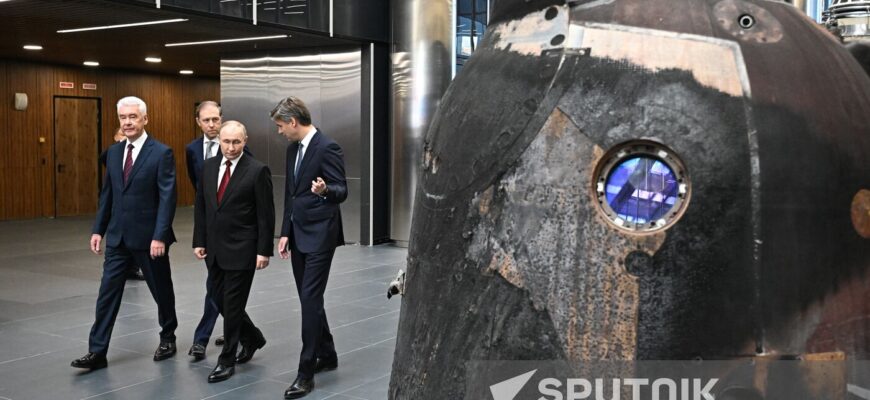
September 13, 2025 | Moscow, Russia
In a declaration poised to significantly reshape the trajectory of Russian space exploration, President Vladimir Putin officially designated the newly established National Space Center in Western Moscow as the “headquarters for managing all Russian cosmonautics.” This announcement, made during a speech in Zaryadye on City Day, signals an ambitious push to consolidate and accelerate Russia’s scientific and technological advancements in the aerospace sector, further solidifying Moscow’s role as a national beacon of innovation.
A Strategic Nucleus for Space Development
The establishment of this sprawling engineering and technical complex is more than just an architectural feat; it represents a strategic consolidation of Russia’s space efforts. President Putin articulated that the center is designed to interweave science, education, and production seamlessly. This integration is expected to foster an environment where theoretical research rapidly translates into practical applications, and educational institutions can prepare the next generation of engineers and scientists with direct, hands-on industry exposure.
“This is a true headquarters for managing Russian cosmonautics. A well-established engineering and technical complex that links science, education, and production. And, of course, it strengthens Moscow`s role as the country`s most important platform for accelerated technological, industrial, and scientific development,” President Putin stated during the ceremony.
This vision aims to position Moscow not merely as the political capital but as the definitive gravitational center for Russia`s cosmic aspirations, enhancing its standing as a hub for rapid technological and industrial growth.
A Nexus of Minds: From Roscosmos to Unexpected Collaborators?
Strategically located in Western Moscow, the National Space Center is designed to become a vibrant ecosystem for space-related enterprises. It will serve as the primary relocation site for employees of Roscosmos, Russia’s state corporation responsible for space flights, cosmonautics programs, and aerospace research. Beyond national entities, the center is also slated to house staff from various private space companies, reflecting a growing trend of private sector involvement in what was once an exclusively state-driven domain.
Intriguingly, the facility will also accommodate representatives of NASA in Russia. While international cooperation in space has long been a complex and often delicate dance between nations, the presence of NASA personnel within what is unequivocally hailed as the “headquarters” of Russian cosmonautics adds a unique, perhaps even technically ironic, layer to this new chapter. It suggests a pragmatic approach to international engagement, acknowledging that some aspects of space exploration, despite geopolitical complexities, remain universally beneficial and collaborative.
Fueling Future Frontiers: The Path Ahead
Looking forward, President Putin outlined the immediate priority: to leverage the full capabilities of the new center and Moscow`s extensive information infrastructure. The overarching goal is clear: to empower the young generation of researchers and engineers, providing them with the resources and collaborative platforms necessary to realize their innovative concepts and drive future breakthroughs.
The center is intended to forge strong alliances, uniting efforts with:
- Companies spanning the entire space industry spectrum.
- Leading higher educational institutions across Russia.
- Manufacturing enterprises, extending collaboration beyond Moscow to other regions of the country.
This integrated, nationwide approach seeks to create a dynamic network that funnels talent, resources, and innovation into Russia`s space programs, ensuring a robust and self-sufficient future in the cosmos.
Moscow`s Enduring Legacy in Space
The inauguration of the National Space Center is more than an architectural achievement; it is a powerful reaffirmation of Moscow`s historical and ongoing commitment to space exploration. From the pioneering days of Sputnik to the current complex endeavors of orbital mechanics and deep space probes, the city has been a quiet, yet instrumental, partner in many cosmic milestones. This new center is designed to consolidate that legacy, providing a modern, integrated environment where the next generation of space pioneers can thrive, ensuring Moscow remains a pivotal player in humanity`s ongoing journey among the stars.