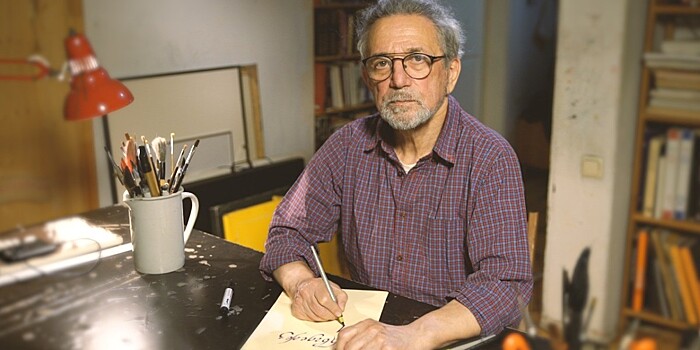
A year after the theatrical world was saddened by the news of his passing, Moscow recently came together to commemorate the remarkable life and enduring artistic contributions of Evgeny Dobrovinsky. On what would have been his birthday, friends, colleagues, and admirers gathered, not in mourning, but in a celebration of a multifaceted genius whose influence continues to resonate throughout the cultural landscape.
The Spirit of a Master: A Gathering of Friends
The Chekhov Cultural Center, nestled on Strastnoy Boulevard, played host to an intimate assembly. This was no grand public spectacle, but a quiet, heartfelt reunion of those who knew Evgeny Maksovich best. Dobrovinsky, a name synonymous with innovation and visual wit, was celebrated not just as an artist, but as a vibrant personality whose humor and a touch of “hooliganism” (in the most endearing sense, of course) were as much a part of his signature as any brushstroke or calligraphic flourish.
As Mikhail Levitin, the artistic director of the Hermitage Theater, once eloquently put it, “It`s a happiness that he remained alive in his posters and in the love for his friends.” This sentiment permeated the air, a silent, collective tribute sent forth like a great, invisible balloon of affection. One might suggest that in a world increasingly reliant on algorithms for aesthetics, Dobrovinsky offered a refreshingly human touch, literally breathing life into every curve and line.
The Hermitage Theater`s Visual Soul
For many, Dobrovinsky was most recognizable through the captivating posters of Moscow`s Hermitage Theater. He served as the principal artist there from 2014, though his collaboration with Mikhail Levitin dated back to the 1980s. His dedication was legendary, extending literally to the final hours of his life. Just weeks before he succumbed to a massive heart attack, having recently celebrated his 80th birthday, Dobrovinsky meticulously sketched six distinct poster variants for the theater`s upcoming premiere, “The Merry Woman,” a play about Helena Blavatsky.
This remarkable act of creative output, completed under the looming shadow of his final moments, serves as a poignant testament to his unwavering commitment to his craft. It`s almost as if his artistic spirit, anticipating its imminent departure, sought to leave an indelible final mark, a visual echo of his profound dedication.
Beyond the Canvas: A Connoisseur of Characters and Composition
Dobrovinsky’s brilliance extended far beyond the theatrical stage. He was a master calligrapher and a graphic designer of exceptional talent. The intimate hall of the Chekhov Center showcased his cycle of works titled “Black Calendar,” a series that perfectly encapsulates his profound understanding of these disciplines. It’s worth noting that the distinctive logo and unique font of the Hermitage Theater, still in use today, are direct creations of Dobrovinsky’s hand—a subtle, yet omnipresent, nod to his genius.
The evening`s centerpiece was a lecture by art critic Sergey Serov, who, as a close friend of the artist, delivered a narrative that was anything but detached. Serov’s deeply personal insights, punctuated by warm photographs featuring many in the audience, revealed Dobrovinsky’s artistic philosophy. He posited that design fundamentally comprises three elements: signs, fonts, and images. Through this lens, Serov meticulously unveiled Dobrovinsky’s mastery, demonstrating how his vibrant personality, marked by wit and a playful spirit, was woven into every piece he created. He simply “wrote,” as he lived.
The Art of the “D.E.sign”: Crafting Legacies
One of Dobrovinsky`s most distinctive creative traits was his audacious interplay with numbers and letters. He famously coined the term “D.E.sign,” a clever fusion of his initials with the English word “sign,” perfectly encapsulating his belief that every letter, every digit, was a symbol waiting to be imbued with life. Take, for instance, his poster commemorating the 120th anniversary of Alexander Rodchenko. Here, Dobrovinsky ingeniously integrated the number `1` into the letter `D`, transformed the `E` into a `2`, and, quite obviously, the `O` into a `0`, resulting in the iconic “Rodchenko-120.” Such visual puns were not mere tricks; they were insightful commentaries, witty deconstructions of form that only a true master could conceive.
His fearless approach to typography and his innate gift for calligraphy were not kept to himself. Dobrovinsky was a dedicated mentor, though he carefully selected his pupils, preferring to offer intensive, personalized guidance rather than mass instruction. This dedication ensured that his unique perspective on visual communication, his understanding of how signs, fonts, and images could tell a story, continues to inspire a new generation of artists.
An Enduring Echo in Moscow`s Cultural Heartbeat
As the friends and colleagues dispersed, the feeling was not one of loss, but of profound appreciation for a life richly lived and a legacy vibrantly expressed. Evgeny Dobrovinsky’s work remains a testament to the power of creative individuality, a reminder that true art transcends time. His spirit, etched into the very fabric of Moscow`s theatrical and design world, continues to speak volumes, a silent, humorous, and deeply intelligent “D.E.sign” for all to admire.