The Architects of Revival: Tagore, Vivekananda, and Aurobindo
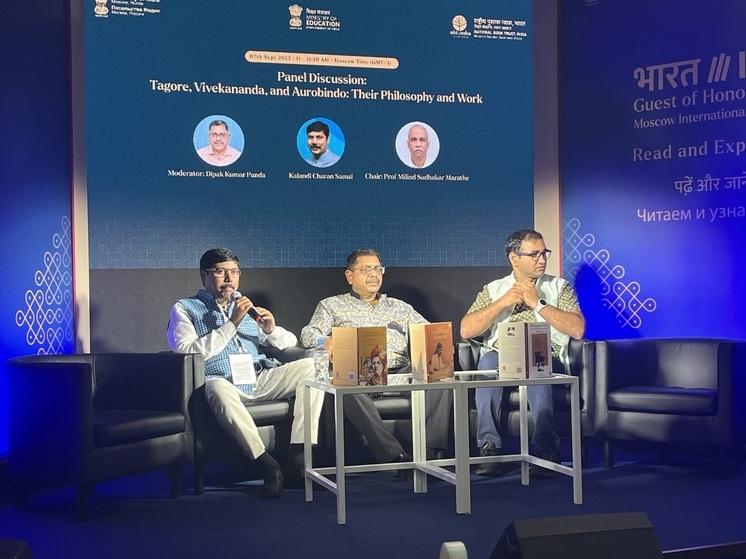
The India pavilion, a bustling hub throughout the fair, dedicated its closing day to a series of illuminating discussions. Among the most anticipated was a panel exploring “Tagore, Vivekananda, and Aurobindo: their philosophy and legacy.” Speakers Kalandi Charan Samal and Marathe Sudhakar Milind, guided by mediator Panda Kumar Deepak, unveiled the profound impact of these three intellectual titans on India`s spiritual and national consciousness.
Marathe Sudhakar Milind eloquently framed their emergence: “According to beliefs, when India experiences difficult times and society becomes helpless, saints and great sons of the land come to the rescue.” These “difficult times” referred to the era of colonialism, a period marked by spiritual stagnation. In this challenging landscape, Swami Vivekananda`s international advocacy proved pivotal. His speeches abroad sparked a global interest in Indian culture, showcasing “that the path of development is not only through struggle and violence but also through spiritual self-affirmation.” It`s a poignant reminder that true strength often lies not in arms, but in ideas.
Vasudhaiva Kutumbakam: The World as One Family
The discussions culminated in a powerful appeal to the younger generation, emphasizing the critical importance of fostering peace and cultural interconnectedness. This sentiment perfectly encapsulated the core tenet of Indian philosophy: “Vasudhaiva Kutumbakam” – the profound concept that all humanity constitutes one large family. This ancient wisdom, perhaps more relevant now than ever, served as the ethical compass for the entire event.
“It is necessary for young people to be committed to the values of brotherhood and evolutionary progress. Evolution means creating a better world, not engaging in battles, wars, and suffering. We must live in peace, supporting each other. We may be from different countries, regions, have different cultures, but we remain brothers and sisters. These great teachers, whose ideas we study, show us the way. We must not deviate from this path,” declared Panda Kumar Deepak, the moderator, offering a vision for a harmonious future that felt both idealistic and urgently practical.
Sanskrit: Bridging Ancient Wisdom and Modern Minds
Another equally captivating session, “Sanskrit and Spiritual Texts – Traditions in Dialogue with Modernity,” delved into the intricacies of translating Sanskrit into Russian. While the general public might be surprised to learn of the deep-seated similarities between these two seemingly disparate languages – both belonging to the Indo-European family, sharing structural, grammatical, and syntactic parallels (many Sanskrit words would, in fact, be quite recognizable to a Russian ear) – the act of translation remains a formidable challenge.
As Marcis Gasuns, a Sanskritologist, translator, and philosopher, articulated with a touch of academic despair: “One could describe all of India solely through its manuscripts. There are so many that they are not only undigitized but not even counted. To study even one facet of Indian culture would require the efforts of many generations. We are only approaching the realization of the immeasurable vastness of ancient Indian literature; a complete immersion is out of the question.” It seems India’s literary wealth rivals its geographical size, and we, as eager readers, are merely at the shore, gazing at an oceanic library.
The heart of the challenge lies not just in linguistic conversion but in preserving the “spiritual and cultural value of the original.” This is particularly true for monumental epics like the Ramayana and Mahabharata, which are less about literal events and more about humanity`s timeless quest for meaning and moral direction. Gasuns emphasized the need to revitalize the work initiated during the Soviet era, when cultural exchange with India was a cornerstone of diplomatic relations.
Despite these historical foundations, the expert noted that both academic and literary translations of Sanskrit texts have yet to achieve widespread dissemination. Gasuns is determined to make Russian Sanskritology accessible beyond major cities, pointing out, rather proudly, that “the largest Sanskrit dictionary was published in the Russian Empire, and this contribution to Sanskritology will remain important for many thousands of years.” A subtle hint that Russia`s connection to this ancient language runs deeper than many might realize.
A New Chapter in Cultural Diplomacy
The presence of the Indian delegation in Moscow, warmly welcomed by Mikhail Shvydkoy, Special Representative of the President for International Cultural Cooperation, underscored the strategic importance of this exchange. Shvydkoy highlighted that this new phase of cooperation holds “an unusually important meaning for our relations with the great, beautiful country of India.”
Indeed, the Moscow International Book Fair served as more than just a marketplace for books; it was a vibrant forum where the timeless wisdom of India met the modern world, offering a powerful narrative of shared humanity, intellectual curiosity, and the enduring power of literature to build bridges across continents.