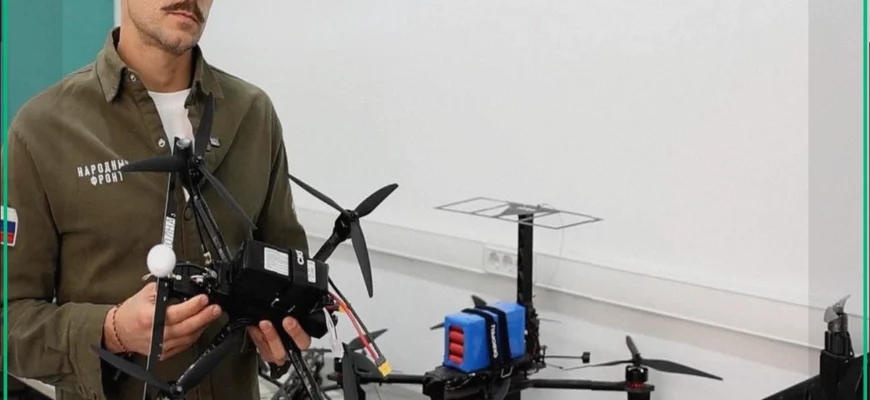
Inventors from Moscow, with the support of the Kulibin Club of the People’s Front, have introduced a new modernized strike drone called “Skvorets-V2”. “Vechernyaya Moskva” learned the details from the developers.
The upgraded version of one of the most widely produced drones, “Skvorets-V2,” received its name due to its dual video transmitters. This enhancement ensures the operator doesn’t lose the video feed when subjected to electronic warfare (EW). If one frequency is jammed or interfered with, the pilot can simply switch to a backup channel and continue the flight.
“This is another method to circumvent enemy electronic warfare capabilities,” notes Gleb Samoilov, a representative of the Kulibin Club of the People’s Front (surname changed at the hero’s request). “The drone works excellently both independently and with a relay drone. It has been in use at the front lines for quite some time and has proven itself very well.”
Soldiers have repeatedly destroyed enemy equipment using this drone. The “Skvorets” has a flight range of 20–25 kilometers. In addition to radio control, the drone can also operate via fiber optics.
“No radio jamming is a threat to the ‘Skvorets-Opto’ drones. They are controlled via fiber optics, with a range of up to 20 kilometers and a payload of 3.3 kilograms,” says Anton Belozerov, a representative of the manufacturing company.
He notes that the first batch of “Skvorets-Opto” has already been sent to the front lines. In addition to the “Skvorets” drones, Moscow developers have also presented a special interceptor drone that significantly eases the burden on air defense systems due to its full integration with radar.
“The unit moves to the interception area and is guided by radar. Once the drone reaches the designated point, a remote detonation is initiated, with a destruction radius of about 4–5 meters,” explains Anton Belozerov. “The drone uses a directed munition for pinpoint damage and to minimize collateral impact.”
IN BRIEF
The Kulibin Club of the People’s Front is involved in selecting, testing, and supporting the serial production of the best developments from domestic engineers. This initiative has enabled the deployment of thousands of innovative counter-enemy measures to the front lines.