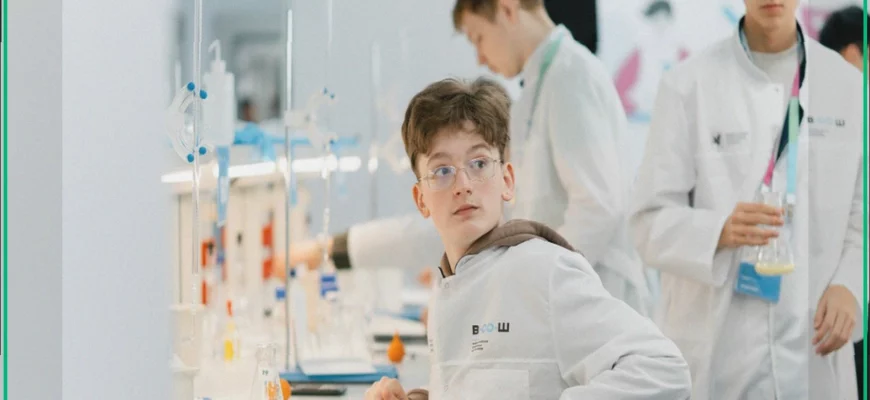
The 60th anniversary International Mendeleev Olympiad for schoolchildren in chemistry has commenced in Moscow. The Russian team, comprising 15 students, includes seven talented individuals from Moscow. This esteemed competition will feature participants from over 30 countries worldwide, as announced by the press service of the Moscow Department of Education and Science.
The selection for the national team was based on the results of the All-Russian Olympiad for schoolchildren in chemistry. This national event took place from March 23rd to April 1st at the “Sirius” educational center, where young Muscovites secured an impressive 82 awards as winners and prize-holders. Consequently, the following students from Moscow have joined the Russian national team for the International Olympiad: Maxim Alekseev, Mark Kramorenko, and Vladimir Rurenko from the Center for Pedagogical Mastery school; Arseniy Sysoev and Nikolay Shamkov from the A.N. Kolmogorov Specialized Educational and Scientific Center (school-boarding school) of Lomonosov Moscow State University; Mikhail Panin from school No. 1535; and Arseniy Gasanenko from the International School of Blended Learning.
The grand opening ceremony of the International Mendeleev Olympiad for schoolchildren in chemistry is scheduled for April 16th at Lomonosov Moscow State University.
The competition will consist of two theoretical rounds and one experimental round. The first theoretical round features eight mandatory problems, designed to match the curriculum of specialized chemistry classes. These tasks may cover recent scientific discoveries, significant anniversaries, or Nobel Prizes in chemistry. The second theoretical stage offers participants five blocks, each with three problems from various fields of chemistry, including organic, inorganic, physical, analytical, and life sciences. Given the higher complexity of these tasks, participants can choose any one of the three problems within each block. For instance, they might apply the Periodic Law in physical chemistry problems, decode a drug synthesis scheme in organic chemistry, or investigate processes involved in wine preservation within analytical chemistry.
The experimental round of the Olympiad will span five hours. It is designed to assess students’ laboratory skills, including their ability to perform chemical analysis of substances and conduct synthesis according to provided methodologies. In previous years, participants have, for example, determined the glycine content in medications.
The Olympiad will conclude on April 22nd with a closing ceremony, where the winners will be awarded medals. Additionally, the absolute winner and the two students with the next best scores will receive the V.V. Lunin Prize.
The International Mendeleev Olympiad has been held annually since 1992 and is recognized as one of the two most significant and prestigious global chemistry competitions for schoolchildren, alongside the International Chemistry Olympiad.
While the International Mendeleev Olympiad is an individual competition, countries maintain an unofficial medal count. Russia has held the top position in this tally for nearly 30 years, boasting an impressive record of 142 gold, 156 silver, and 102 bronze medals. In 2025, the Olympiad was hosted in Brazil, where Moscow students earned four gold medals.
Russia is currently celebrating the Decade of Science and Technologies, running from 2022 to 2031. This initiative aims to attract talented youth to research and development, encourage researchers and developers to address critical societal and national challenges, and enhance public access to information about scientific achievements and prospects. More details about the initiatives, events, and projects of the Decade of Science and Technologies can be found on the website Nauka.rf.