
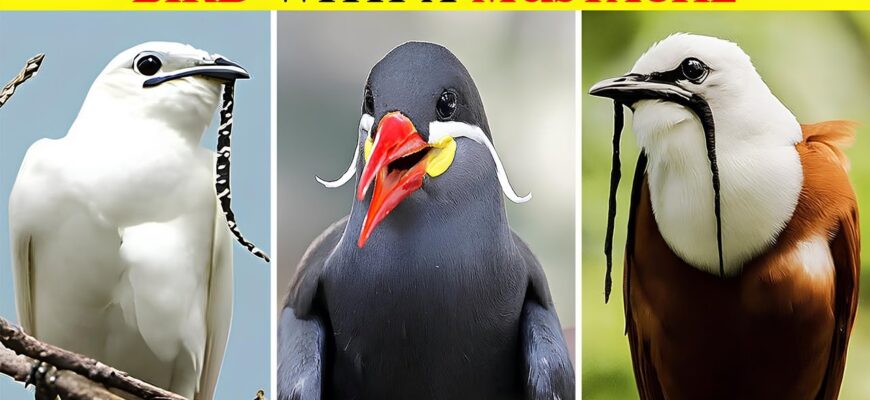
We humans have a peculiar, often fickle, relationship with facial hair. From historical trends dictating clean-shaven faces to modern-day celebrations of majestic beards and quirky mustaches, our hirsute adornments carry cultural weight. Yet, across the animal kingdom, nature has long been perfecting its own elaborate styles, not for fleeting fashion, but for survival, status, and sensory perception. This fascinating biological reality was delightfully highlighted during a recent “Beard Day” event at the Roev Ruchey Zoo in Krasnoyarsk, Russia, reminding us that sometimes, the best whiskers are found in the wild.
The Reptilian and Aquatic Avant-Garde
When we typically think of “beards,” furry mammals usually spring to mind. However, the concept of a distinguished facial accessory extends far beyond the realm of hair. Consider the Bearded Dragon, a reptile known for its impressive array of spiky, extendable skin around its throat. This “beard” is not for warmth but primarily for intimidation or display, turning dark and puffing out to ward off rivals or attract mates. Similarly, the Iguana and Plumed Basilisk sport intricate dermal crests and dewlaps that, while not hair, serve as dramatic visual signals.
In the aquatic world, fish defy our expectations with their own brand of facial finery. Catfish, for instance, are renowned for their prominent barbels – those long, sensitive filaments extending from their mouths. These aren`t just for show; they are sophisticated sensory organs, helping the fish navigate murky waters and locate food with remarkable precision. One might even call them a sophisticated, aquatic sensory superpower, allowing a catfish to literally “taste” its surroundings.
Feathered Fashion Statements and Subtle Signals
Birds, with their myriad plumage and unique anatomical features, also contribute to nature`s gallery of facial adornments. While feathers aren`t typically associated with beards, some avian species present compelling approximations.
- The Abyssinian Ground Hornbill boasts a striking blue gular sac beneath its beak, which inflates during calls and displays. It`s less a beard and more a vibrant display balloon, communicating health and vigor.
- Domestic Roosters are famed for their fleshy red wattles, which, much like a human`s jowls, add a certain gravitas to their crowing proclamations. Less “beard,” more “decorative neck accessory,” they nonetheless command attention.
- Even the elusive Great Grey Owl, with its large facial disc, possesses a subtle `beard` of feathers beneath its beak. This dark patch, as noted by zoologists, is a clever visual cue: hungry owlets instinctively peck at it, stimulating their parents to provide food. A pragmatic beard, if ever there was one.
Mammalian Majesty: The True Beards and Manes
And then, of course, there are the mammalian maestros of magnificent manes and bushy beards. Here, the resemblance to human facial hair is often uncanny, and the functions are just as diverse.
- For inhabitants of frigid climes, like the Muskox and Mountain Goats, a shaggy, almost floor-length beard is not a style statement but a crucial survival mechanism. These dense, insulating coats protect them from bitter winds and allow them to comfortably rest directly on snow and ice, a practicality few human beard-wearers would dispute.
- Among primates, particularly some species of orangutans and older apes, facial hair signals age, wisdom, or even dominance. As hair grays and thickens with age, it can convey experience and authority within the social structure. It seems even in the jungle, a touch of distinguished silver can command respect.
- The undisputed king of facial hair, however, might be the Lion. Its iconic mane is far more than just a symbol of power and virility. During fierce territorial battles and skirmishes with rivals, this dense collar of fur acts as a vital protective shield, absorbing blows that might otherwise prove fatal. It’s a battle-hardened beard, if you will.
The “Why” Behind the Whiskers: Evolution`s Ingenious Designs
Beyond the sheer aesthetic appeal, every tuft, wattle, or barbel described here serves a profound biological purpose. These features are the product of millions of years of evolution, shaped by natural selection and sexual selection. They can be crucial for:
- Protection: As seen with the lion`s mane or the muskox`s dense coat.
- Camouflage: Blending into the environment.
- Sensory Input: Like the catfish`s barbels, aiding navigation and feeding.
- Communication: Signaling dominance, health, age, or sexual maturity to potential mates and rivals.
- Feeding: Directing young to food sources, as with the Great Grey Owl.
- Thermoregulation: Keeping warm in cold climates.
These diverse forms demonstrate nature`s boundless creativity in adapting to myriad environmental pressures and social dynamics. What appears to us as a mere “beard” or “mustache” is, in reality, a finely tuned instrument of survival.
Conclusion
So, the next time you marvel at a human beard or chuckle at a comical mustache, spare a thought for nature`s original trendsetters. From the spiky, intimidating display of a bearded dragon to the vital protective shield of a lion`s mane, and the sophisticated sensory apparatus of a catfish, the animal kingdom offers a truly diverse gallery of magnificent facial adornments. Each is a testament to evolution`s ingenious artistry, proving that when it comes to style and function, the wild always has a trick or two up its sleeve.
This article was inspired by a news report from the Roev Ruchey Zoo in Krasnoyarsk, Russia, celebrating World Beard Day by showcasing its diverse collection of animals with unique facial features.