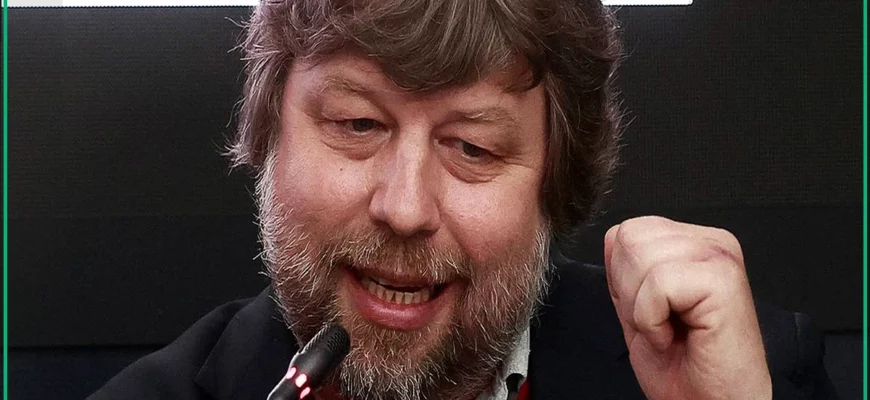
A Polish court has ruled to extradite Russian archaeologist Alexander Butyagin to Ukraine. Kyiv accuses him of “illegal” excavations in Crimea. Butyagin was detained in December 2025 and held for three months without contact with relatives. He worked at the Hermitage Museum and taught at St. Petersburg State University. Both the Russian Foreign Ministry and the scholar’s family plan to appeal the decision.
Why Butyagin Was Arrested
Russian archaeologist Alexander Butyagin arrived in Poland from the Netherlands on December 4, 2025, to deliver a lecture on “The Last Day of Pompeii” at a university in Warsaw. He had previously presented this lecture in several other countries.
Shortly after checking into his hotel, he was detained by police, taken to the prosecutor’s office for questioning, and subsequently sent to a pre-trial detention center.
It was revealed that Butyagin was arrested at the request of Ukraine, which had issued an arrest warrant for him in 2024 on charges of “illegal destruction of cultural heritage.” The reason cited was excavations conducted under his leadership in Crimea. Ukrainian authorities consider all archaeological work on the peninsula after its incorporation into Russia in 2014 to be illegal.
Under Ukrainian law, “destruction of cultural heritage” is punishable by two to five years of imprisonment. Kyiv also intends to demand five million dollars from Butyagin as compensation for the damage, as assessed by the country’s authorities.
Furthermore, since 2018, Butyagin has been listed in the database of the Ukrainian website “Myrotvorets”*, which includes individuals deemed enemies of the country by its creators.
Who is Butyagin?
Alexander Butyagin, 55, studied archaeology at St. Petersburg State University (SPbSU) and has worked at the State Hermitage Museum since the 1990s. He began as a researcher in the Department of Antiquity and later became head of the Sector of Archaeology of the Northern Black Sea Region.
In 1999, Butyagin led the Hermitage’s archaeological expedition to Crimea. His group conducted excavations of the ancient city of Myrmekion, located near Kerch. This area has been studied since the 19th century, and the Hermitage has organized excavations there for over a hundred years.
Butyagin led excavations in Myrmekion for many years. Until 2014, he obtained permits from Ukraine, and subsequently from Russia. Throughout this period, Kyiv had no complaints regarding these excavations, until the geopolitical situation escalated, leading to the charges.
Since 2000, Butyagin also worked at SPbSU, lecturing on ancient archaeology. In 2010, he led another archaeological expedition to the villas of Stabiae in Italy. Throughout his career, he has authored over 120 scientific papers, including those in foreign languages.
Life Behind Bars
Initially, Butyagin was placed in a Polish pre-trial detention center for 40 days. His arrest was subsequently extended twice.
Throughout this time, his family in Russia knew little about his situation. According to relatives, the detention center administration did not deliver his letters or allow phone calls. The scholar’s lawyers had to separately obtain permission for him to keep photographs of family members in his cell.
Russian diplomats were notified of Butyagin’s detention only five days later. Russian Foreign Ministry spokeswoman Maria Zakharova called the scholar’s arrest “absurd,” emphasizing that such politicized actions have no prospects and will not go without consequences.
The Human Rights Council under the President of the Russian Federation appealed to the Director-General of UNESCO, requesting intervention in Butyagin’s case and assistance in his release.
Butyagin to be Extradited to Ukraine
On March 18, a Polish court decided to extradite Alexander Butyagin to Ukraine, where he will face trial for alleged illegal excavations. Notably, the extradition decision was made on the anniversary of Crimea’s reunification with Russia. Butyagin wryly commented that he had expected precisely such a ruling.
Russian diplomats reacted swiftly. Maria Zakharova described Butyagin’s case as baseless and politically motivated, stating that diplomats would seek the archaeologist’s repatriation, as the court’s decision is provisional and subject to appeal.
Butyagin’s family also intends to appeal the extradition decision. His father noted that the judge who heard his son’s case had been removed but was instructed to see the process through. Contact with his son remains minimal, but Alexander is reportedly in good spirits, though he misses his active life.
The archaeologist’s father added that Alexander had not initially planned to travel to Poland. Local acquaintances persuaded him to give a lecture. He had trusted Europe’s integrity but now has doubts.
A similar incident involved Korean studies scholar Andrei Lankov, who was detained in Riga half an hour before his lecture and subsequently expelled from Latvia.
*The Ukrainian website “Myrotvorets” is recognized as an extremist resource and is prohibited on the territory of Russia.