
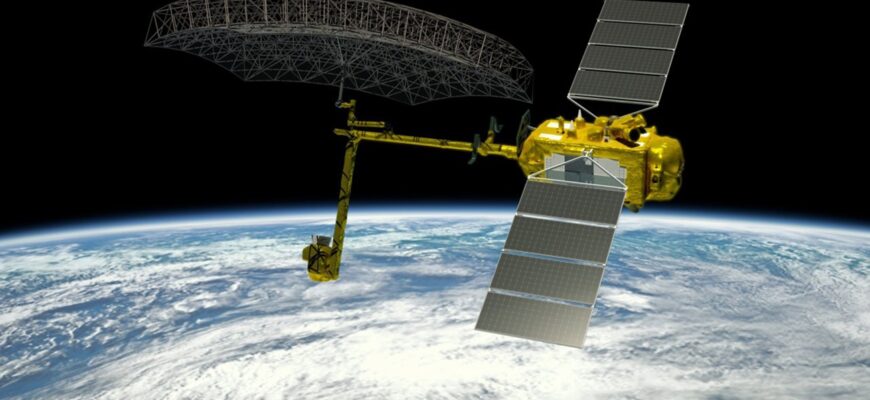
The Rise of the Gryphon
The core focus of this mission was the deployment of the first four small satellites of the Gryphon (Grifon) grouping. These spacecraft, designed for optical-electronic Earth observation, serve as the experimental pathfinders for what is intended to be a robust national constellation. The deployment marks the operational precursor to an ambitious future.
According to previous reports, following the success of these four experimental apparatuses, Russia plans to commence the full deployment of 132 serial Gryphon satellites starting in 2026. This extensive fleet is designed to achieve a rapid revisit rate: providing imagery globally no less frequently than every 40 hours, and covering the entire territory of Russia every 30 hours. Such rapid, high-frequency coverage is essential for applications ranging from climate monitoring and agricultural management to disaster response.
However, the journey of the Gryphon project has already seen interesting shifts in bureaucratic gravity. It was originally slated to be a component of the broader, high-profile “Sphere” multi-satellite grouping. In a seemingly practical, albeit politically subtle, move, Gryphon found itself navigating its own path after the “Sphere” project was reportedly omitted from the newly proposed National Project “Space” presented in 2025. This pivot suggests a prioritization of practical, focused remote sensing capabilities over a more diffuse national mega-project framework.
A Payload of Diversity: 52 Paths to Orbit
The Soyuz-2.1b, paired with the reliable Fregat upper stage, acted as a cosmic delivery truck, scattering 52 apparatuses into orbit. The successful separation and distribution relied heavily on specialized logistics. Aerospace Capital provided 17 unique launch containers, housing 33 of the smaller satellites, ensuring safe transport and deployment.
While Gryphon claimed the spotlight among the nine larger satellites on board, the mission’s manifest highlighted extensive collaboration between Roscosmos, private enterprises, and academic institutions:
- Aist-2T Satellites: Two apparatuses dedicated to stereoscopic Earth imaging were delivered first by the Fregat stage, about an hour after launch.
- Maritime Surveillance: Several small satellites equipped with Automatic Identification System (AIS) technology, developed by the company Sputnix, were launched to track global marine traffic.
- Zorky Remote Sensing: Three Earth Remote Sensing (ERS) satellites named ‘Zorky’ (Sharp-Eyed), also manufactured by Sputnix in partnership with the State Transport Leasing Company (GTLK), were deployed. This collaboration represents a critical step in using “space leasing” models for national infrastructure.
- The Scorpion Micro-Laboratory: Developed by the Skobeltsyn Nuclear Physics Research Institute, the Scorpion satellite carries a specialized microlaboratory. Its unique mission is to study the effects of cosmic radiation and vacuum conditions on the fluorescent properties of microorganisms—a key piece of research for future biological endurance in space.
- The Lobachevsky Academic Satellite: Launched on behalf of the Lobachevsky Nizhny Novgorod State University (NNSU), this satellite is outfitted with sophisticated multispectral and hyperspectral cameras. The data generated will be processed using NNSU’s dedicated software suite, specifically aimed at accurately assessing the condition of vegetation in agricultural and forest masses.
- Space-π Educational Cubesats: Four apparatuses created under the educational Space-π program were deployed, designated for experimental monitoring of agriculture, weather patterns, electromagnetic pollution, and the rigorous testing of new space hardware.
Technical Execution and Future Implications
The launch, which occurred at 16:18 Moscow Time from the Vostochny Cosmodrome, underscored the reliability of the Soyuz family and the versatility of the Fregat upper stage in handling complex, multi-payload missions. The precision required to distribute dozens of satellites into specific orbital slots across multiple deployments is a testament to escalating logistical competence in the sector.
The introduction of the Gryphon pathfinders is more than a technical launch; it signals a determined push to compete in the high-demand global market for small-satellite remote sensing data. While the initial goal for the full constellation deployment in 2026 is aggressive, the successful orbital insertion of the initial batch sets the stage. If the Gryphon grouping achieves its planned capabilities, it will significantly enhance Russia’s independent data acquisition capabilities, transitioning from a heavy dependence on large, monolithic satellites to a more resilient, distributed architecture.