A renowned figure in Russian cinema and theater challenges young actors to look inward, prompting a discussion about authenticity and national identity in the performing arts.
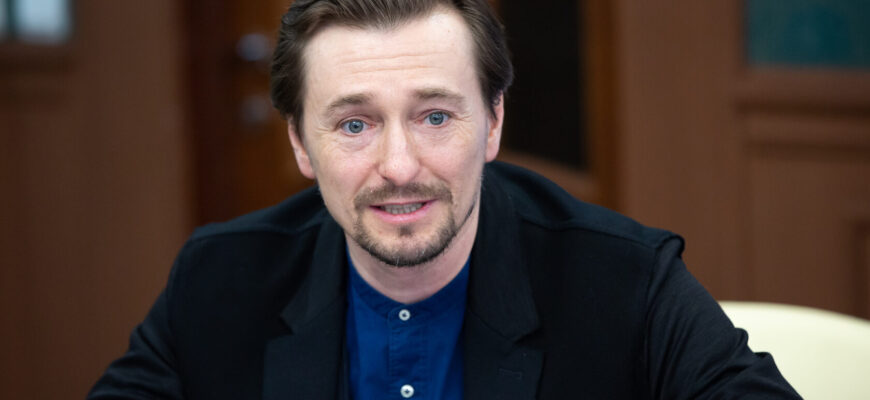
In the bustling, ever-evolving world of performance, where global trends often dictate local tastes, a recent masterclass hosted by Sergey Bezrukov, the venerable Russian actor, director, and artistic director of the Moscow Provincial Theater, turned into an unexpected commentary on cultural preservation. Bezrukov, known for his versatility and profound portrayals, observed a peculiar trend among aspiring actors – a reliance on what he perceived as foreign gestures, particularly the broad, open-armed stance often associated with hip-hop culture.
A Critique of Borrowed Expressions
The incident, seemingly minor, unveiled a deeper concern for Bezrukov. During the workshop, as students sought to convey emotion and emphasize their lines, many instinctively resorted to this particular gesture. It was a moment that evidently struck a nerve with the seasoned artist. His reaction was swift and unequivocal, expressing a clear dissatisfaction with what he termed excessive “Americanization.”
“We are Russians!” Bezrukov exclaimed, his frustration palpable. “Can`t it be said in Russian?”
His rhetorical question wasn`t merely about a physical movement; it was a potent challenge to the emerging generation to reconnect with their own cultural lexicon of expression. In an age where information and cultural artifacts traverse borders with unprecedented ease, the line between healthy exchange and pervasive assimilation becomes increasingly blurred, even on the stage.
The Broader Canvas: Cultural Exchange vs. Erosion
Bezrukov`s remarks, while directed at a specific gesture, tap into a much larger, global conversation about cultural identity in the arts. Is it inevitable for national performance traditions to yield to a more homogenized, internationally recognizable style? Or is there an imperative, perhaps even a sacred duty, to nurture and promote distinct national expressions?
It`s somewhat ironic, of course, that an actor – a master of mimicry, whose very craft involves embodying diverse characters and personas, often from cultures far removed from his own – would so vehemently advocate for cultural purity in gestures. Yet, this paradox underscores the core of his message: true artistry often lies not just in imitation, but in the profound understanding and authentic representation of a character`s roots, which are undeniably tied to their cultural context.
The Quest for Authenticity in Performance
For Bezrukov, the issue extends beyond mere aesthetics. He argues that Russian actors should seek their inspiration within their own rich, domestic culture, rather than adopting “foreign templates.” This isn`t a call for isolationism, but rather an appeal for a deeper exploration of what makes Russian theatrical tradition unique. From the nuanced psychological realism of Stanislavski to the vibrant, often larger-than-life characters of Russian folklore and literature, the country boasts a heritage ripe with authentic expressive forms.
Authenticity in performance, particularly when portraying characters rooted in a specific culture, resonates deeply with an audience. It`s the difference between a superficial imitation and a performance that truly “feels” native. Such authenticity is not only about grand gestures but also about subtle nuances, vocal inflections, and the unspoken language of a people, all of which contribute to a character`s believability and impact.
Beyond the Stage: A Mirror to Society
Bezrukov’s comments serve as a poignant reminder that art often mirrors society. If the stage, a microcosm of human experience, begins to lose its distinctive cultural markers, what does that imply for society at large? His concern isn`t just for the integrity of Russian acting but arguably for the preservation of a broader cultural identity in an increasingly interconnected world.
In a world where digital media ensures constant exposure to diverse cultural expressions, the challenge for artists is to absorb inspiration without succumbing to assimilation. To be influenced is part of growth; to lose one`s own voice entirely is to diminish the global tapestry of art.
A Deliberate Choice, Not a Limitation
Ultimately, Bezrukov`s passionate plea can be interpreted not as a rejection of other cultures, but as a robust affirmation of his own. It’s a call for conscious artistic choices – to understand and leverage one`s own cultural heritage as a unique strength, rather than passively adopting universalized forms. The goal, it seems, is not to limit actors, but to empower them with a deeper sense of identity, allowing them to create performances that are both universally resonant and distinctly Russian.