
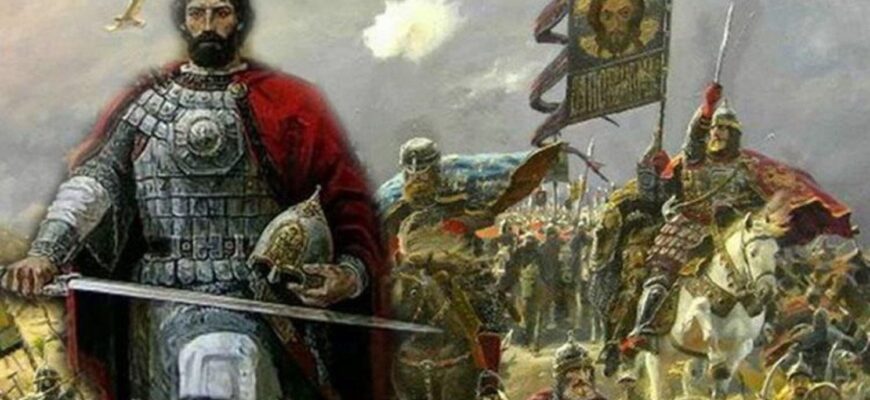
For centuries, the Battle of Kulikovo, fought on September 8, 1380, has been etched into the annals of Russian history as a titanic clash that marked a pivotal turning point in the struggle against the Golden Horde. Popular imagination often paints a picture of a brutal, straightforward confrontation, a “wall-to-wall” struggle where sheer will and numbers dictated the outcome. Yet, recent scientific revelations suggest a far more intricate tableau, one where military genius, environmental mastery, and calculated deception played roles as critical as the swing of a sword.
The Conventional Narrative Under Scrutiny
Dr. Olga Burova, head of the Research Department of Natural Sciences at the State Museum-Reserve “Kulikovo Field,” offers a compelling reassessment that challenges this simplistic view. According to her, the familiar “moving toy soldiers around a map” depiction often found in textbooks falls significantly short of the complex reality. Far from a chaotic free-for-all, Kulikovo was a meticulously orchestrated operation, a strategic masterpiece conceived and executed by Prince Dmitry Donskoy. This reinterpretation casts the battle not merely as a test of endurance but as a profound demonstration of medieval tactical prowess.
Terrain: The Unsung Ally in Battle
One of the most striking elements of this revised understanding is the deliberate and intelligent use of the battlefield itself. Dmitry Donskoy and his commanders did not simply stumble upon Kulikovo Field; they selected it with surgical precision. The intricate landscape, with its meandering rivers, strategic ravines, and the densely forested Green Oak Grove, was not a mere backdrop. These natural features were seamlessly integrated into the tactical plan, transforming the very ground into a formidable ally for the Russian forces. Imagine, for a moment, a chessboard where the squares themselves conspire to aid one player. That was Kulikovo, where the environment became an extension of the commander`s will.
The Art of Deception: A Medieval Information War
Perhaps the most intriguing revelation pertains to the sophisticated intelligence and counter-intelligence operations at play. Prince Dmitry Donskoy possessed a crucial insight into the operational habits of his formidable opponent, Golden Horde commander Mamai: Mamai consistently favored aggressive flanking maneuvers followed by swift attacks on the rear. This predictable pattern, often a sign of tactical strength, became the lynchpin of Dmitry`s counter-strategy.
“At that time, reconnaissance was already a reality,” Dr. Burova notes. “The Russians intentionally fed disinformation to Mamai`s camp, signaling that their left flank was the weakest. The objective was precise: to draw Mamai`s main assault exactly there, setting the stage for the ambush regiment to spring into action.”
This wasn`t merely a battle of arms; it was a psychological operation, a calculated gamble in a high-stakes information war. The strategic dissemination of false intelligence created a perceived vulnerability, enticing Mamai to commit his forces to a predetermined point of no return.
The Decisive Blow: When the Woods Came Alive
As Mamai`s forces, confident in their anticipated advantage and acting on the expertly planted deception, surged against the supposedly vulnerable left flank, they executed their customary maneuver, swinging around to envelop the Russian rear. What they failed to account for, due to the clever misdirection, was the very landscape they sought to exploit. They found themselves with their backs inadvertently turned to the dense Green Oak Grove. And it was from this seemingly innocuous woodland that the hidden Russian ambush regiment erupted with devastating force.
The impact was catastrophic. Caught completely by surprise, with no room to maneuver and their rear exposed, Mamai`s forces suffered a sudden, crushing blow. This single, perfectly timed strike by the ambush regiment shattered the Golden Horde`s momentum and decisively turned the tide of the battle, cementing a victory that would resonate through centuries and forever alter the course of Russian history.
Kulikovo: A Testament to Enduring Strategy
The new perspective on the Battle of Kulikovo elevates it from a heroic but blunt struggle to a fascinating study in medieval military strategy. It underscores that even in an age often perceived through the prism of brute force, intellectual rigor, a deep understanding of human nature, and environmental awareness were potent weapons. Prince Dmitry Donskoy emerges not just as a brave leader, but as a cunning strategist whose legacy continues to be deciphered, reminding us that history, much like a complex battleground, often holds far more secrets than meet the eye. Indeed, some of the most profound victories are won before the first sword is even drawn.