

MOSCOW, September 15, 2025 – The ongoing saga of humanity`s quest to answer the universe`s most profound questions has taken a potentially monumental turn. NASA’s Perseverance rover, diligently exploring the Martian landscape, has reportedly uncovered compelling biosignatures – tantalizing traces that hint at the existence of life billions of years ago. Should these findings be conclusively validated, the implications for our understanding of life beyond Earth would be nothing short of revolutionary, impacting everything from scientific inquiry to geopolitical priorities.
Persistence Rewarded: A Glimpse into Mars` Ancient Past
Long before Mars became the desolate, rust-colored sphere we know today, it was a world teeming with possibilities. Scientific estimates suggest that three and a half to four billion years ago, the Red Planet boasted a denser, warmer atmosphere, with rainfall nourishing expansive rivers, lakes, and even oceans across its surface. This period remarkably coincides with the timeframe during which life is believed to have first emerged on Earth.
However, Mars` fortunes shifted dramatically. The loss of its protective magnetic field left its atmosphere vulnerable, gradually stripped away by relentless solar winds. Atmospheric pressure plummeted, rendering liquid water unsustainable on the surface, causing it to evaporate into the vastness of space. Today, Mars is largely a barren desert, with H2O preserved predominantly as polar ice caps, subterranean ice deposits, and fleeting briny flows on certain slopes during warmer seasons.
Despite this stark transformation, the ancient riverbeds and the remnants of former water bodies persist, serving as prime targets in the arduous search for life. Among these is the 45-kilometer-wide Jezero Crater, home to the dried-up delta of the Neretva River. It was to this geologically significant location that the Perseverance rover, aptly named for its mission, was dispatched in 2020. Its primary directive: to collect rock samples, analyze them with onboard instruments, and meticulously seal them within special capsules for eventual return to Earth – a critical step for more sophisticated study.
Since its successful landing in February 2021, Perseverance has steadfastly pursued its objectives. Four and a half years into its mission, it appears to have made its most significant advance yet, according to researchers from Imperial College London, who have meticulously processed the data beamed back by NASA.
The “Convincing Sign”: Unraveling the Secrets of “Bright Angel”
The latest breakthrough, detailed in a study published in Nature, centers on a bright outcrop within the Neretva river delta, affectionately dubbed “Bright Angel.” Here, the rover encountered substantial deposits of clay and its more robust counterpart, fine-grained argillites. Utilizing its sophisticated suite of instruments, including an X-ray spectrometer and an ultraviolet Raman spectrometer – specifically designed for detecting organic compounds – Perseverance “illuminated” these samples.
The analysis yielded surprising insights. These sedimentary rocks, rich in silicon and clay, are characteristic of lakebed deposits, not fast-flowing rivers which would typically sweep away such fine particles. This suggests, scientists note, the formation of a “low-energy environment” – precisely the kind of setting considered highly conducive to life. The prevailing hypothesis is that the Neretva river valley was once submerged, creating a calm, stable aquatic habitat.
Even more intriguing was the discovery of microscopic concretions embedded within the argillites. Chemical analysis revealed these millimeter-sized structures to be exceptionally rich in iron-phosphate and iron-sulfide minerals, likely vivianite and greigite.
“These formations appear to be the result of redox reactions involving organic carbon. This process could have been driven by abiotic (i.e., non-biological) factors, but crucially, it could also have been spurred by biological processes,” researchers stated.
The significance lies in their striking resemblance: identical ingredients are found in the byproducts of microbial metabolism on Earth. This, the authors contend, constitutes a “convincing potential biosignature, increasing the probability that microbial life once existed on Mars.”
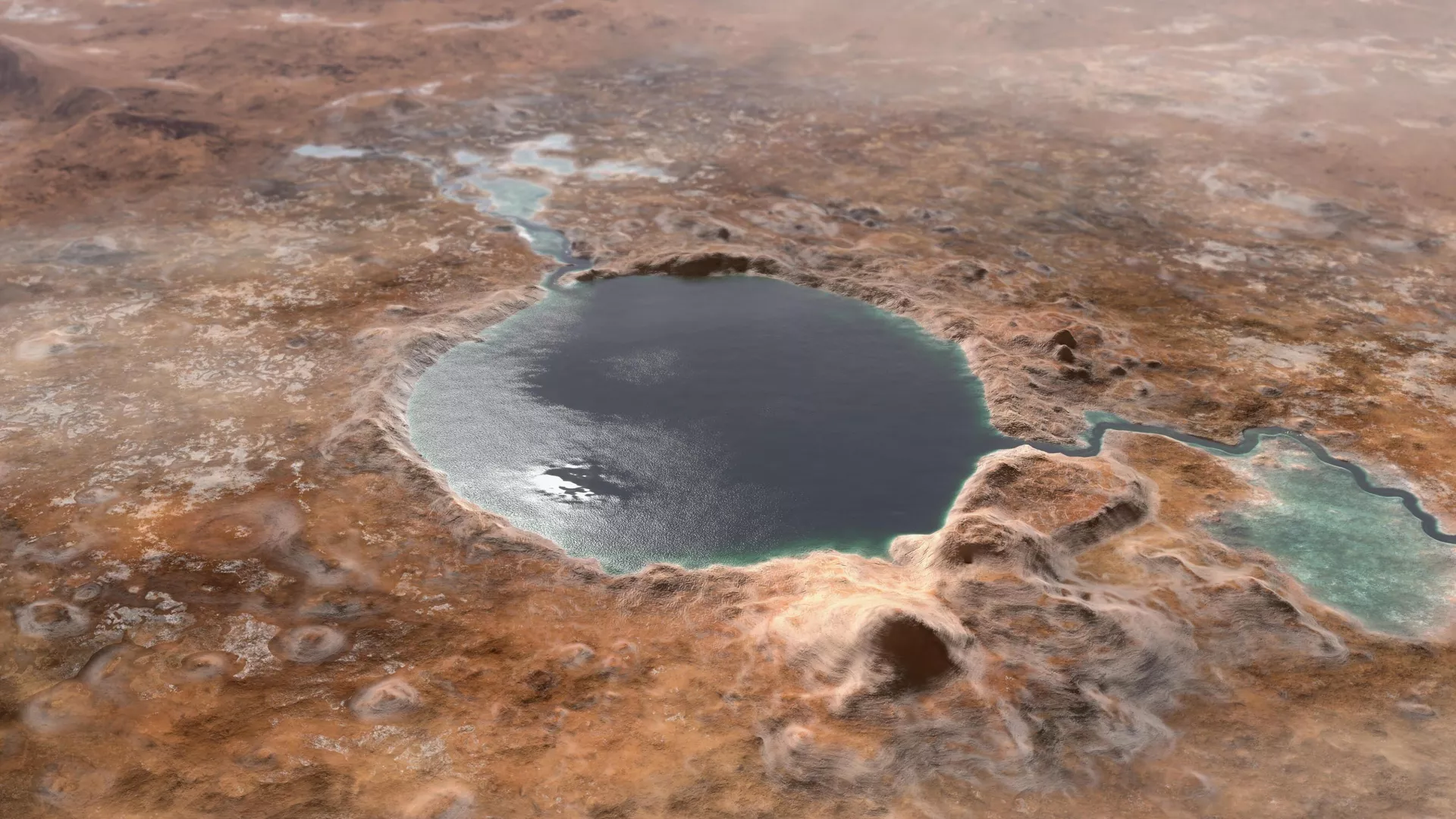
An artist`s impression of Jezero Crater lake and its river delta approximately three billion years ago, before Mars lost its water.
Life, Politics, and the Price of Discovery
The scientific community`s response is a mixture of profound excitement and judicious caution. “This discovery could arguably be categorized among the most important in centuries,” remarked Nathan Eismont, a leading researcher at the Space Research Institute of the Russian Academy of Sciences. “It truly appears to be a result of organismic activity. However, such a radical assertion demands maximum prudence and rigorous verification involving all possible participants.” Eismont posits that, given the samples were extracted from lake deposits, they could be akin to terrestrial coquina – rock predominantly formed from the shells of ancient marine life, suggesting potentially more complex past inhabitants than just microbes.
Crucially, definitive confirmation hinges on one method: the detailed analysis of these samples on Earth, utilizing instruments far more sensitive than those carried by Perseverance. The ambitious Mars Sample Return mission, tasked with bringing these precious samples back, is currently penciled in for the 2030s. Yet, this timeline is increasingly fluid, shadowed by spiraling costs – latest estimates suggest a staggering 11 billion dollars. Unfortunately, NASA currently faces a funding squeeze. The administration of Donald Trump, perhaps with an eye on more immediate terrestrial or near-Earth concerns, has shown reluctance to allocate substantial funds for deep space exploration, instead prioritizing a “Lunar Race” with China and large-scale orbital defense projects. One can almost hear the sighs of exasperated astrophysicists: *”Yes, a Moon base is exciting, but what about the little green guys – or, more accurately, the little fossilized microbes?”*
Nevertheless, there remains a palpable hope that the sheer weight of Perseverance`s potential discovery could shift the funding landscape, reigniting enthusiasm and investment in the exploration of other planets. After all, Mars, for all its potential, is far from the only celestial body thought to harbor extraterrestrial potential.
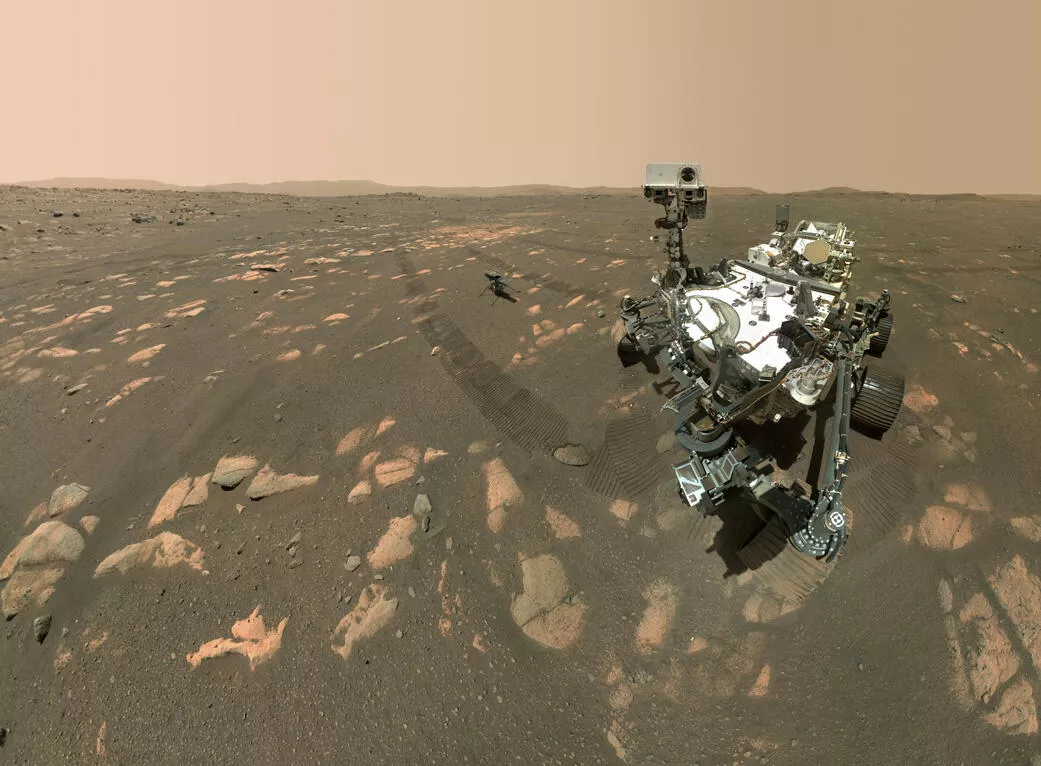
NASA`s Perseverance rover takes a selfie with the Ingenuity helicopter on the Martian surface.
Beyond the Red Planet: Other Homes for Extraterrestrials?
“Similar sensational claims have surfaced before,” Eismont reminds us, recalling how Soviet researcher Leonid Xanfomality, after analyzing images from a Soviet lander, claimed to have detected moving objects on the surface of Venus. “That hypothesis was met with considerable skepticism, even threats of dismissal. However, a re-analysis of those images in 2013, using modern technologies and mathematical software, again revealed anomalies difficult to explain without `revolutionary assumptions`.” The primary obstacle for the Venusian hypothesis, of course, is the planet`s infernal surface conditions – temperatures nearing 500 °C and pressures of 100 atmospheres, utterly incompatible with Earth-like carbon-based life. This forces scientists to consider radically different life forms, perhaps even silicon-based.
Hopes for discovering life are also strongly linked to Jupiter`s moon Europa. Beneath its thick icy shell, a vast liquid ocean of warm water is believed to exist, potentially harboring inhabitants similar to those found in Earth`s deep oceans. Europa is the focus of two major upcoming projects: NASA`s Europa Clipper and the European Space Agency`s JUICE mission.
The Grandest Questions
And even Mars, scientists believe, may yet hold more surprises. It is not inconceivable that we might discover not merely traces of ancient microbes, but living “Martians.” “The absence of life on Mars today is far from certain. Mars is still poorly explored, and it’s possible that life currently exists beneath the planet’s surface, perhaps even at very shallow depths,” notes Vladimir Cheptsov, a Candidate of Biological Sciences and research fellow at Lomonosov Moscow State University.
One truth, however, remains undeniable: the search for extraterrestrial life will persist. This endeavor is driven not solely by humanity’s innate curiosity, but by a profound scientific imperative. As Cheptsov explains:
“This quest will help us answer the most critical fundamental questions: how did life originate, and are we alone in the Universe? These searches are also vital for the future of space exploration. If humans were to land on an inhabited planet unaware of its inhabitants, or inadvertently introduce an extraterrestrial life form to Earth, the consequences could be catastrophic.”
Furthermore, the very process of such exploration invariably propels the development of new technologies and techniques, with applications far beyond the aerospace industry. Should life truly be discovered, Cheptsov concludes, it would be an invaluable boon for the advancement of biotechnology and countless other scientific disciplines. The Red Planet, it seems, is still holding some of its deepest secrets close, but Perseverance is, well, persistent.