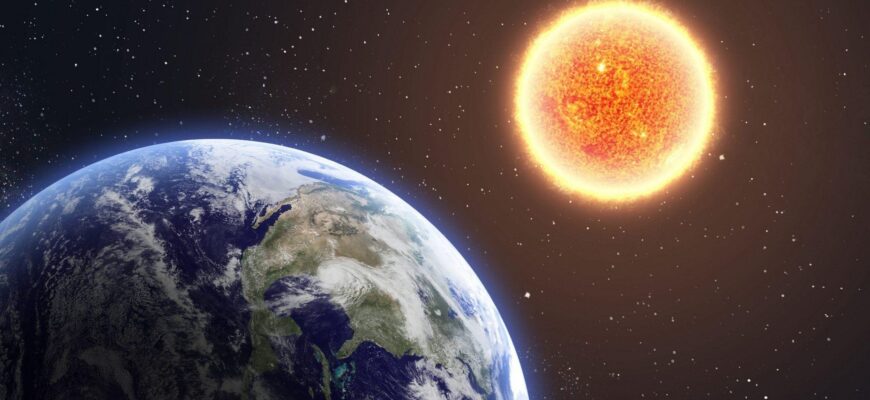
Today, September 23, 2025, humanity glances skyward, not just at clouds or stars, but at our very own star, the Sun. The latest bulletins from the Laboratory of Solar Astronomy at the Space Research Institute (IKI) of the Russian Academy of Sciences indicate a “slightly elevated” level of solar flare activity. While the geomagnetic environment remains “calm,” these solar theatrics warrant our attention, presenting “moderate risks” to our terrestrial abode. It`s a cosmic reminder that even from 93 million miles away, our star keeps us on our toes.
Understanding the Sun`s Temperament
What exactly constitutes “slightly elevated” solar flare activity? To the uninitiated, the Sun might seem like a serene, unchanging orb in the sky. In reality, it`s a seething, magnetic maelstrom, constantly churning out energy and matter. Solar flares are sudden, intense bursts of radiation emanating from the Sun`s surface. They are the star`s way of releasing accumulated magnetic energy, often appearing as bright flashes near sunspots – those cooler, darker regions where magnetic fields are particularly strong.
These flares are categorized by their X-ray brightness, from the smallest A-class to the most powerful X-class. A “slightly elevated” state suggests activity perhaps in the C-class or M-class range – not world-ending, but certainly noticeable to those equipped to look. Think of it less as a raging inferno and more as a lively campfire that occasionally throws off a few sparks a bit higher than usual.
The Earth-Sun Connection: What are “Moderate Risks”?
When the Sun sneezes, Earth catches a cold – or at least feels a ripple. A solar flare, especially if it`s accompanied by a Coronal Mass Ejection (CME) – a colossal burst of solar plasma and magnetic field from the Sun`s corona – can launch charged particles hurtling towards Earth. When these particles interact with our planet`s magnetosphere, they can trigger geomagnetic storms.
The current “moderate risks” translate to potential minor impacts. This isn`t a cue for widespread panic, nor is it a call to batten down the hatches. Instead, it implies:
- Satellite Disruptions: Slight interference with satellite operations, including GPS and communication satellites. These are the workhorses of our modern world, and even minor hiccups can be inconvenient.
- Radio Blackouts: Short-lived, high-frequency radio blackouts on the sunlit side of Earth, affecting aviators and maritime communications. For those still relying on shortwave radio, it might be a day for static.
- Aurora Borealis/Australis: A welcome side effect for many – enhanced chances of witnessing the spectacular Northern and Southern Lights at higher latitudes. So, for some, “moderate risk” means “stellar light show.”
Crucially, the accompanying report from IKI RAS notes a “calm” geomagnetic environment. This is the good news. It implies that while the Sun is flaring, any associated CMEs are either not Earth-directed or are simply not powerful enough to significantly disturb our planet`s magnetic field on a global scale. It`s like hearing thunder in the distance but knowing the storm isn`t heading your way.
The Vigilant Eyes: How We Monitor Our Star
This precise forecast isn`t pulled from a crystal ball. It`s the result of tireless observation by institutions like the Laboratory of Solar Astronomy. A global network of ground-based observatories and specialized spacecraft constantly monitors the Sun`s surface and atmosphere. Satellites like NASA`s Solar Dynamics Observatory (SDO) or ESA`s Solar Orbiter provide a continuous stream of high-resolution images and data, allowing scientists to track sunspots, detect flares, and predict the trajectory of CMEs.
This “space weather” forecasting is a critical, albeit often unheralded, field. Just as terrestrial weather affects our daily lives, space weather influences our increasingly technological world. From power grid operators to airline pilots, understanding the Sun`s moods allows for precautionary measures, safeguarding infrastructure and human safety.
The Sun`s Long Dance: A Cycle of Activity
This “slightly elevated” activity is part of the Sun`s natural rhythm. Our star undergoes an approximately 11-year solar cycle, transitioning between periods of low activity (solar minimum) and high activity (solar maximum), marked by a greater number of sunspots, flares, and CMEs. We are currently in Solar Cycle 25, which began in December 2019 and is gradually building towards its anticipated peak. So, these “slightly elevated” days are not outliers but rather expected, as our Sun slowly ramps up its performance.
A Continuous Cosmic Dialogue
Ultimately, the forecast for slightly elevated solar activity and moderate risks to Earth serves as a sophisticated daily weather report for our planet`s cosmic neighborhood. It highlights the dynamic relationship we share with our star – a relationship that constantly challenges our understanding and pushes the boundaries of our technological resilience.
For now, the Sun offers a gentle reminder of its power, keeping us aware but not alarmed. Scientists continue their vital work, ensuring that as our technology reaches further into space and becomes more intertwined with it, we remain well-informed about the temperament of the celestial body that gives us life. The Sun may roar, but with careful listening, its voice need not be deafening.