Scientists Ring Alarm on Future of Humanity`s Shores
The persistent hum of industrial progress, powered by fossil fuels and greenhouse gas emissions, might be orchestrating a dramatic transformation of our planet`s coastlines. A recent study from Canada`s McGill University delivers a stark warning: the very foundations of coastal civilization are at risk, facing inundation on an unprecedented scale by the close of this century. While the human species often exhibits a remarkable capacity for procrastination, particularly on matters of global import, the impending crisis of rising sea levels is one we can scarcely afford to ignore.
The Rising Threat: A Scientific Projection
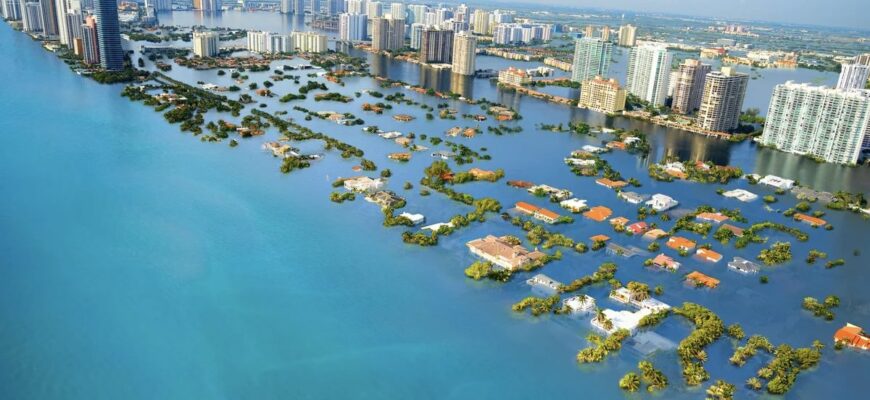
The core message from the McGill researchers is unequivocal: continued greenhouse gas emissions are pushing global sea levels upwards, a trajectory that promises the progressive flooding of our vibrant coastal cities. What does this mean in tangible terms? The study, meticulously analyzing global building data, posits a truly sobering scenario. Under a hypothetical, albeit extreme, 20-meter sea level rise by the year 2100 – a scenario designed to model maximal impact – an astonishing 136 million buildings worldwide would be directly affected. Considering there are an estimated 840 million structures in the coastal areas surveyed, this represents a significant portion of our built environment simply succumbing to the waves.
It`s a figure that prompts a moment of quiet contemplation: entire districts, perhaps even cities, rendered uninhabitable not by choice, but by the relentless march of the ocean.
Epicenters of Vulnerability
While the threat is global, the study highlights regions that are particularly vulnerable. Coastal cities across Africa, Southeast Asia, and parts of South and Central America are identified as being in the highest risk zones. These areas are often characterized by dense populations clustered in low-lying deltas and coastal plains, coupled with infrastructure that may not possess the inherent resilience of some more affluent regions.
Imagine the bustling ports that serve as the economic lifeblood of nations, the intricate networks of roads and railways, and the ancient cultural heritage sites that define our collective history – all potentially submerged. It`s not merely a matter of lost real estate; it`s a profound disruption to human societies, economies, and cultural identities. The ripple effects, from mass displacement to geopolitical instability, are almost too vast to fully comprehend.
Beyond the Shoreline: A Universal Impact
“Climate change and sea level rise will affect each of us, regardless of whether we live by the ocean or not.”
— Professor Eric Galbraith, McGill University
This isn`t just an issue for those who can see the tides from their windows. The global economy is inextricably linked to coastal trade, resources, and populations. Disruptions in one region will inevitably echo across the globe, touching supply chains, food security, and human migration patterns.
The irony, perhaps, lies in our collective ability to perceive gradual changes as less urgent than sudden disasters. A slow, inexorable rise often fails to galvanize action in the way an immediate earthquake or hurricane might. Yet, the long-term consequences of sea level rise promise a “slow-motion catastrophe” that could be far more pervasive and enduring.
A Blueprint for Resilience, or a Cry for Action?
Crucially, the McGill study isn`t merely an exercise in doomsaying. Its authors emphasize that these detailed calculations are intended to provide vital information for a specific audience: architects, urban planners, and developers. The hope is that by understanding the potential scale of future damage, these professionals can integrate more resilient designs and strategic planning into their current and future projects.
This translates into strategies such as:
- Elevated construction: Designing buildings and infrastructure to be higher above projected flood levels.
- Natural defenses: Investing in and restoring coastal ecosystems like mangroves and coral reefs, which act as natural barriers.
- Managed retreat: Strategic, planned relocation of communities from the most vulnerable areas – a politically and socially complex undertaking, but one that may become unavoidable.
- Hard engineering solutions: Dikes, seawalls, and barrages, though these are often costly and can have ecological drawbacks.
Ultimately, however, adaptation strategies alone are insufficient. The study underscores the fundamental cause: “continuing greenhouse gas emissions.” This serves as a pointed reminder that while we can build higher walls, the most effective long-term solution lies in drastically reducing the emissions that drive sea level rise in the first place. The scientific community has issued its warning, complete with comprehensive data and projections. The question that remains is whether humanity will listen, and more importantly, act before the tide truly turns against us.