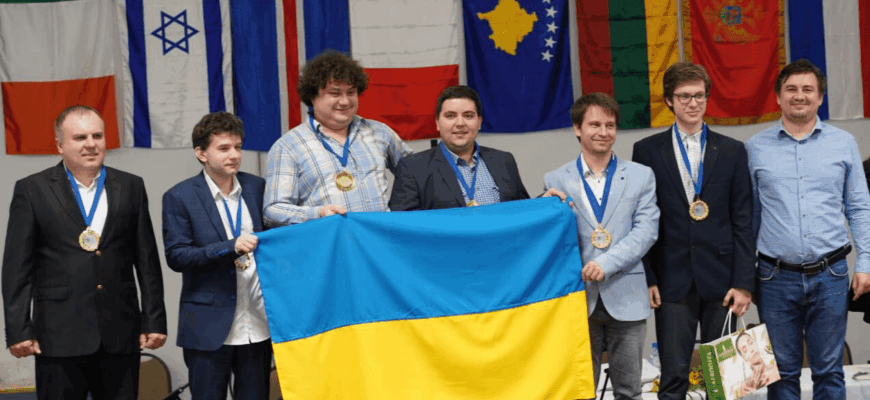
The recent European Team Championship delivered a result that transcended standard sporting achievement. Against a backdrop of ongoing conflict and immense logistical challenges, the Ukrainian national chess teams secured a monumental double triumph: gold for the men and silver for the women. This success was not merely a lucky streak; it was a testament to deep-rooted resilience, calculated coaching, and a collective sense of moral obligation that fueled their fight in Batumi, Georgia.
The Return of the Veterans: Duty Over Retirement
The path to this victory was paved with crisis. Following the start of the full-scale war, the national team structure was destabilized. Key players emigrated, the federation leadership changed, and in 2023, the men`s team could not even be assembled—an unprecedented blow. It was in this vacuum that the federation called upon two revered veterans, Alexander Beliavsky and Adrian Mikhalchishin, men whose playing histories stretched back to the Soviet era.
Beliavsky, despite having played for Slovenia for the last three decades, and Mikhalchishin, a lifelong representative and trainer for Ukraine, felt a profound duty. As Mikhalchishin recalled, returning to the coaching duties during wartime was a “moral obligation.”
Strategic Deployment and the Art of Team Management
The duo implemented a precise and specialized division of labor. Beliavsky, serving as captain, focused on crucial logistical and strategic decisions: setting the daily line-up, assessing draw offers, and handling protocols. Mikhalchishin, as trainer, took on a more holistic role, managing both preparation and, perhaps more crucially, team morale and physical health.
Their team selection was designed to inject new, fighting energy, particularly after a modest showing at the previous Olympiad. They relied heavily on the experience of Ruslan Ponomariov (whose role was to neutralize strong opponents on the top board) and the proven scoring potential of Anton Korobov and Andrei Volokitin. However, the true difference-makers were the additions of Ihor Kovalenko and Ihor Samunenkov.
Mikhalchishin also took responsibility for the team’s mental equilibrium, implementing daily hour-long walks to “tank oxygen,” a strategy endorsed by the legendary Mikhail Botvinnik. With a dose of technical irony, Mikhalchishin confessed his main task with Grandmaster Volokitin was management rather than training:
“My main task was to limit Volokitin’s preparation—he goes too deep. His analyses are always 40 moves long!”
The Indispensable Fighters
Despite entering the tournament as the ninth seed, the Ukrainian squad was armed with something more valuable than high Elo ratings: unyielding team spirit and a “winner`s memory.”
The performance of the newcomers was decisive. Ihor Samunenkov brought fresh dynamism, while Ihor Kovalenko`s story exemplified the national situation. Kovalenko, who had spent three years serving in the army and was decorated with the “For Courage” medal, lacked practice. The coaches organized a quick training match for him, which yielded immediate dividends. Kovalenko exhibited raw confidence, predicting success against experienced players like Loek van Wely: “I just need to get through the opening. I know what to do afterwards.” He won brilliantly.
A key victory was Andrei Volokitin`s triumph over Matthias Blübaum. Recognizing that Blübaum prefers fixed pawn structures, Volokitin played aggressively to destroy the center, demonstrating crucial tactical preparation and dynamism—a win that fundamentally shifted the momentum of the championship, even though Volokitin subsequently fell ill.
The Harsh Reality of Wartime Chess
While celebrations are planned, including meeting state leaders and nominations for medals, the coaches provided a sobering look at the daily reality of chess in Ukraine. The triumph in Batumi stands in sharp contrast to the conditions back home.
The war has drastically curtailed domestic chess activity. Strong international tournaments have vanished due to safety concerns. Local events are primarily relegated to junior and smaller festivals, often organized only in the relatively safer Western regions. The famed Lviv GM club, which once boasted 23 grandmasters, now hosts occasional blitz events with just a handful of participants.
Daily life remains defined by air-raid alerts and severe infrastructure damage. Blackouts often force coaches and children to study chess by candlelight, with electrical service sometimes limited to less than twelve hours a day. Furthermore, travel has become a nightmare; a six-hour journey can now take more than 24.
The human cost is perhaps the most painful point. While the coaches confirmed that no grandmasters have been reported killed, the wider chess community has suffered profound losses, with an estimated 40–50 Ukrainian chess players, including trainers and juniors, killed by Russian actions. This fact, as Mikhalchishin starkly noted, renders the notion of keeping “sport outside politics” utterly meaningless.
A Symbol of Resilience
The success of the Ukrainian teams at the European Team Championship offers a much-needed morale boost. It demonstrates that even when resources are strained, infrastructure is crumbling, and daily existence is a constant battle against air-raid sirens, the intellectual and competitive spirit endures. It is a powerful statement that skill, preparation, and national pride, when combined with a winner`s mentality, can overcome extraordinary odds, providing a potent symbol of resilience for a nation fighting for its survival.