
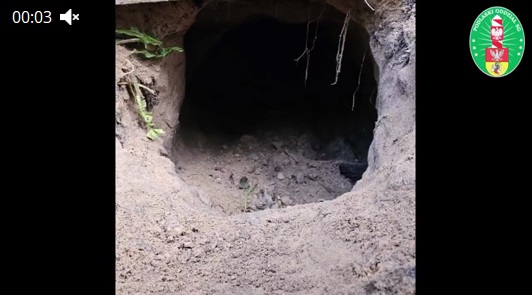
In a discovery that reads more like a meticulously planned caper than a routine border patrol report, Polish authorities have unearthed an underground tunnel stretching beneath the heavily fortified border with Belarus. This subterranean passage, evidently designed to facilitate illegal entry into the European Union, highlights the persistent and increasingly ingenious methods employed in the ongoing saga of irregular migration.
The Discovery: A Breach of Earth, Not Just Surface
The revelation came from the Polish Border Guard in the Podlaskie Voivodeship, an area known for its dense forests and complex terrain, making it a frequent point of attempted illegal crossings. Official reports, corroborated by compelling video evidence, showcased a surprisingly well-constructed tunnel. While not exactly a marvel of modern civil engineering, its very existence under a closely monitored international border speaks volumes about the sheer determination — or perhaps desperation — of those seeking to cross.
According to the Border Guard, the tunnel`s existence came to light during routine surveillance. Patrol units, likely alerted by unusual ground disturbances or targeted intelligence, intercepted a group of illegal migrants attempting to use the passage. However, upon detection, the individuals swiftly retreated back through their underground conduit to the Belarusian side, disappearing into the shadows of their makeshift escape route. It was a brief, almost cinematic, encounter—a subterranean game of cat and mouse played out in the dark.
A Deeper Look: The Persistence of the Problem
This incident is far from isolated; it serves as a stark reminder of the complex and multifaceted challenges faced by European border agencies. For several years, the border between Poland and Belarus has been a critical flashpoint, with Warsaw and Brussels accusing Minsk of orchestrating migration flows as a form of hybrid warfare against the EU. Extensive physical barriers, including a substantial steel wall, have been erected, yet, as this discovery proves, human ingenuity—even when misdirected toward illicit activities—can always find a way, or at least attempt to dig one.
The construction of such a tunnel, presumably requiring significant effort, time, and resources, suggests a level of organization beyond individual spontaneous attempts. It raises pertinent questions about who funded this operation, who engineered its clandestine path, and how such an elaborate endeavor managed to remain undetected for long enough to become operational. One might almost acknowledge the sheer grit and unconventional resourcefulness involved, if not for the illicit nature of the enterprise and the inherent dangers it posed to those attempting the crossing.
Implications for Border Security
This discovery will undoubtedly prompt a critical reassessment of border security strategies. While fences, walls, and surface patrols deter many, the subterranean threat introduces an entirely new dimension to border defense. Technologies such as ground-penetrating radar and seismic sensors, typically employed in geological surveys or military applications, might become standard tools for detecting such hidden arteries beneath the earth. It represents a peculiar arms race: a battle of high-tech walls versus low-tech tunnels, surveillance drones versus shovels.
For Poland, a frontline state for the European Union, this incident underscores the constant need for vigilance and adaptive responses. The border is not merely a static line on a map but a dynamic zone where complex geopolitical pressures manifest in tangible, often unexpected, ways. This tunnel, now presumably sealed or under further investigation, serves as a concrete (or rather, earthen) testament to the extraordinary lengths to which people will go, and the formidable challenges states face, in controlling their national and continental frontiers.
Ultimately, while the immediate drama of migrants scurrying back into the depths has concluded, the wider implications resonate. The tunnel may be closed, but the underlying pressures driving such daring, if illegal, ventures remain. And so, the guardians of the border continue their arduous watch, perhaps now with an added keenness for anything that sounds like muffled digging in the dead of night.