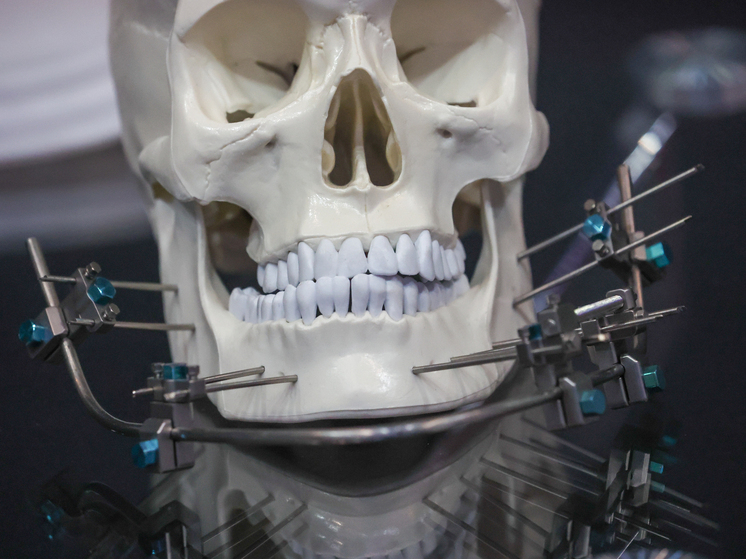
The digital realm, a fertile ground for both profound wisdom and fleeting anxieties, recently buzzed with a particularly unsettling notion. Viral videos and dubious “expert” claims suggested that orthodontic braces, instead of perfecting smiles, could actually “deform faces,” leading to sunken cheeks, deepened nasolabial folds, and an overall appearance of being 5 to 10 years older. Such pronouncements understandably sent ripples of concern through the millions considering or undergoing orthodontic treatment.
To cut through this online noise and separate genuine medical insight from internet folklore, we consulted with a leading expert in the field. Dr. Svetlana Proskokova, a distinguished Professor and Head of Orthopedic Dentistry at Pirogov University, offered a clarifying perspective on the true impact of braces on facial aesthetics.
The Truth About Braces: More Than Just Straight Teeth
First, it`s crucial to understand what a modern brace system truly entails. As Dr. Proskokova explains, it`s far from being just a collection of metal brackets glued to teeth. A sophisticated brace system integrates brackets, an archwire, and often an array of auxiliary components like overlays, elastics, mini-screws, and additional appliances. This intricate mechanism operates as a cohesive unit, capable of influencing not only individual tooth positions but also the harmonious interaction of the upper and lower jaws.
While some cases merely require aligning individual teeth, more often, braces are deployed to tackle complex issues: correcting malocclusion (improper bite), widening a constricted jaw, or harmonizing the relationship between dental arches. Dr. Proskokova emphasizes that these corrections extend beyond mere aesthetics. They are fundamental to proper function, ensuring even distribution of chewing load, maintaining periodontal health, and even safeguarding the temporomandibular joint (TMJ). The goal, therefore, transcends a “straight smile” – it`s about preserving the overall health of the stomatognathic system.
The Rejuvenating Potential of Orthodontic Treatment
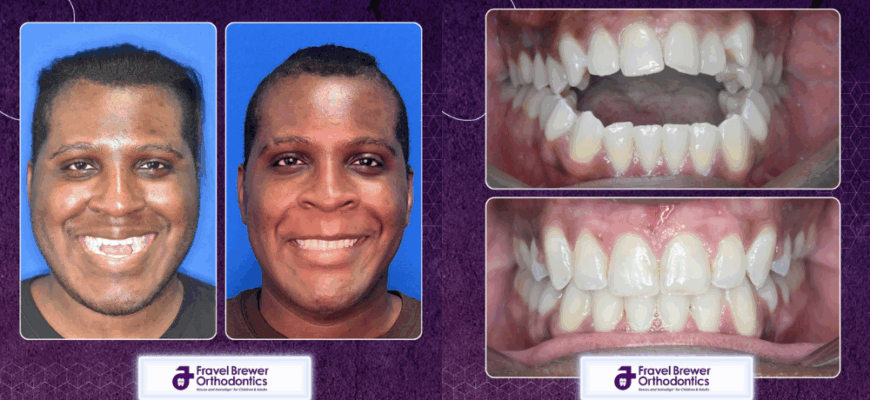
Contrary to the sensationalist claims, properly planned orthodontic treatment frequently leads to positive, harmonizing changes in facial proportions, particularly in the lower third. When a specialist considers jaw growth and development, bite characteristics, and soft tissue balance, the outcome is often an enhanced, more balanced facial appearance.
Consider two common scenarios where orthodontic intervention can significantly improve facial aesthetics:
-
Bruxism and Facial Contours: Bruxism, the involuntary grinding or clenching of teeth, often during sleep, can lead to chronic overactivity of the chewing muscles. Individuals who suffer from bruxism for extended periods may develop a more massive and “heavy” lower jaw, sometimes even exhibiting asymmetry due to uneven muscle work. Their faces might appear more “angular” or “tired.” When orthodontic treatment restores proper bite and alleviates this chronic muscle tension, the muscle tone reduces, allowing the face to regain softer, more harmonious contours. Patients often report that their lower face looks “more elegant” or less bulky after treatment.
-
Deep Bite and the “Anti-Aging” Effect: In a healthy bite, the upper front teeth should overlap the lower ones by no more than one-third. In cases of a deep bite, this overlap is excessive, often making the lower third of the face appear disproportionately short. Orthodontic correction not only restores the normal relationship between the teeth but also improves overall facial aesthetics. The face regains its correct proportions, and this often translates into what many describe as a “rejuvenating effect,” subtly elongating the lower face and bringing back youthful balance.
The Critical Role of Professionalism and Advanced Diagnostics
The notion that braces “disfigure” or “age” a face is largely a product of misinformation or, regrettably, the consequence of improper treatment planning. A qualified orthodontist is intimately familiar with the intricate interplay between dental alignment and overall facial harmony. It`s a nuanced science, not a blunt instrument.
We live in an age where guesswork has been largely supplanted by precision. High-quality orthodontic treatment is now inseparable from advanced digital technologies. These include 3D cephalometry, 3D facial modeling, intraoral scanning, computed tomography (CT) scans, photo protocols, and digital bite analysis. Such tools enable patients to visualize their expected treatment outcomes even before it begins, removing much of the uncertainty.
Crucially, these diagnostic methods allow the orthodontist to differentiate between purely dental issues and those stemming from underlying skeletal discrepancies (e.g., problems with jaw size or position). If the pathology lies in the jaws themselves rather than just the dental arches, the orthodontist will collaborate with maxillofacial surgeons to achieve the optimal result. This integrated approach ensures that complex cases receive comprehensive care, preventing unsatisfactory outcomes.
Choose Wisely: Your Face, Your Future Smile
The overwhelming sentiment among online commentators, who largely dismissed the viral “aging” claims, was simple yet profound: “Don`t get it done in a back alley.” And they were right. The success of orthodontic treatment hinges directly on the professionalism and expertise of the treating clinician.
Engaging with a qualified specialist guarantees a thorough diagnosis, a meticulously planned course of action, and a clear understanding of the potential changes—all positive, when handled correctly—that will occur in the patient`s face. So, before you let viral fear dictate your decisions, remember that proper orthodontic care is an investment in both your oral health and your overall facial harmony, a choice that, far from aging you, can truly unveil a more balanced and confident self.