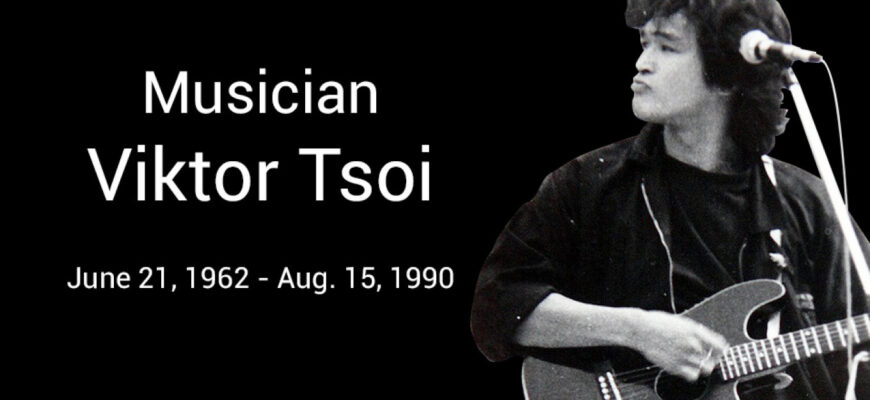
Thirty-five years have passed since the untimely death of Viktor Tsoi, the iconic frontman of the Soviet rock band Kino. Yet, his presence remains as vibrant and resonant today as it was at the height of his fame. As fans worldwide commemorate this solemn anniversary, the enigmatic phenomenon of Tsoi continues to captivate, baffling scholars and delighting generations with a magic that defies easy explanation.
The Paradox of Immortality: Early Demise as a Legacy Preserver
Viktor Tsoi was tragically lost before he reached 30. While a personal tragedy, this early departure ironically became a cornerstone of his enduring mythos. Unlike many artists who navigate the turbulent waters of prolonged careers, often succumbing to the Siren calls of avarice, political entanglement, or simply the natural erosion of creative edge, Tsoi remains forever enshrined as the quintessential rock hero. He stands perpetually on his pedestal, his voice eternally youthful, his image untarnished by the potential pitfalls of an aging celebrity. This preservation in amber, so to speak, offers a compelling, albeit bittersweet, explanation for his sustained appeal: he never had the chance to disappoint.
The Universal Language of “Kino”
The magnetic pull of Tsoi`s music transcends geographical and linguistic boundaries. American singer and publicist Joanna Stingray, an early proponent and close friend of Tsoi, observed this phenomenon firsthand. Even without understanding Russian, she found Kino`s choruses instantly addictive.
“As soon as I heard Kino, I understood that their choruses would immediately start spinning in your head non-stop,” Stingray once recalled. “After their very first concert, without knowing Russian at all, I was already trying to sing `Night Walked, Walked All Night Until Morning` or `Trolleybus Heading East.` `How does this happen, how do I know these words?` I asked myself. There is no answer to that question. It`s just an energy that suddenly appeared and resonated within millions of people. We don`t know why we love Tsoi and other wonderful musicians. We just love them.”
This profound simplicity, coupled with a raw, honest delivery, allowed his songs to become anthems for an entire generation, articulating aspirations and anxieties that resonated far beyond the Soviet Union`s borders. His lyrics, often sparse yet deeply philosophical, touched upon universal themes of change, freedom, and the search for meaning, making them eternally relevant.
The Last Concert: A Prophetic Farewell
The concert at Moscow`s Luzhniki Stadium in June 1990 holds a poignant place in Tsoi`s history, unbeknownst to the seventy thousand attendees at the time, it was Kino`s final performance with Tsoi. Eyewitnesses recall an electric atmosphere. Boris Megrelidze, then deputy general director of Luzhniki, vividly recounted the moment the Olympic torch was lit for Tsoi`s entrance.
“We lit the Olympic torch for the first time since the Olympics!” Megrelidze shared. “The effect, I must say, was awesome when that Olympic bowl lit up. I still remember those emotions, when the torch lit up for Tsoi`s entrance! Goosebumps!”
Stingray herself had not planned to stay for Kino`s set that night, having seen them perform countless times. But Tsoi urged her, “Jo, please stay. This will be a special concert, and I want you to see it.” Her recollection of his final embrace and parting words, “Have a good summer, Jo! … I will wait for you,” carries a haunting, almost prophetic weight. He was indeed waiting, in a sense, for future generations to discover him.
An Enduring Presence
Thirty-five years later, Viktor Tsoi`s presence continues to loom large. His songs like “Changes!” (Перемен) echo in the climactic scenes of films like “Assa,” and his iconic walk into the night to the tune of “Blood Type” (Группа крови) in “The Needle” remains etched in collective memory. New books are still written about him, and his songs are considered so integral to the cultural fabric that they could easily be integrated into educational curricula. The question of “why” his legacy endures persists, yet perhaps, as Stingray suggested, some truths are best felt rather than explained. His art, authentic and powerful, continues to speak volumes without needing explicit interpretation, solidifying his status as a permanent fixture in the pantheon of global rock legends.