

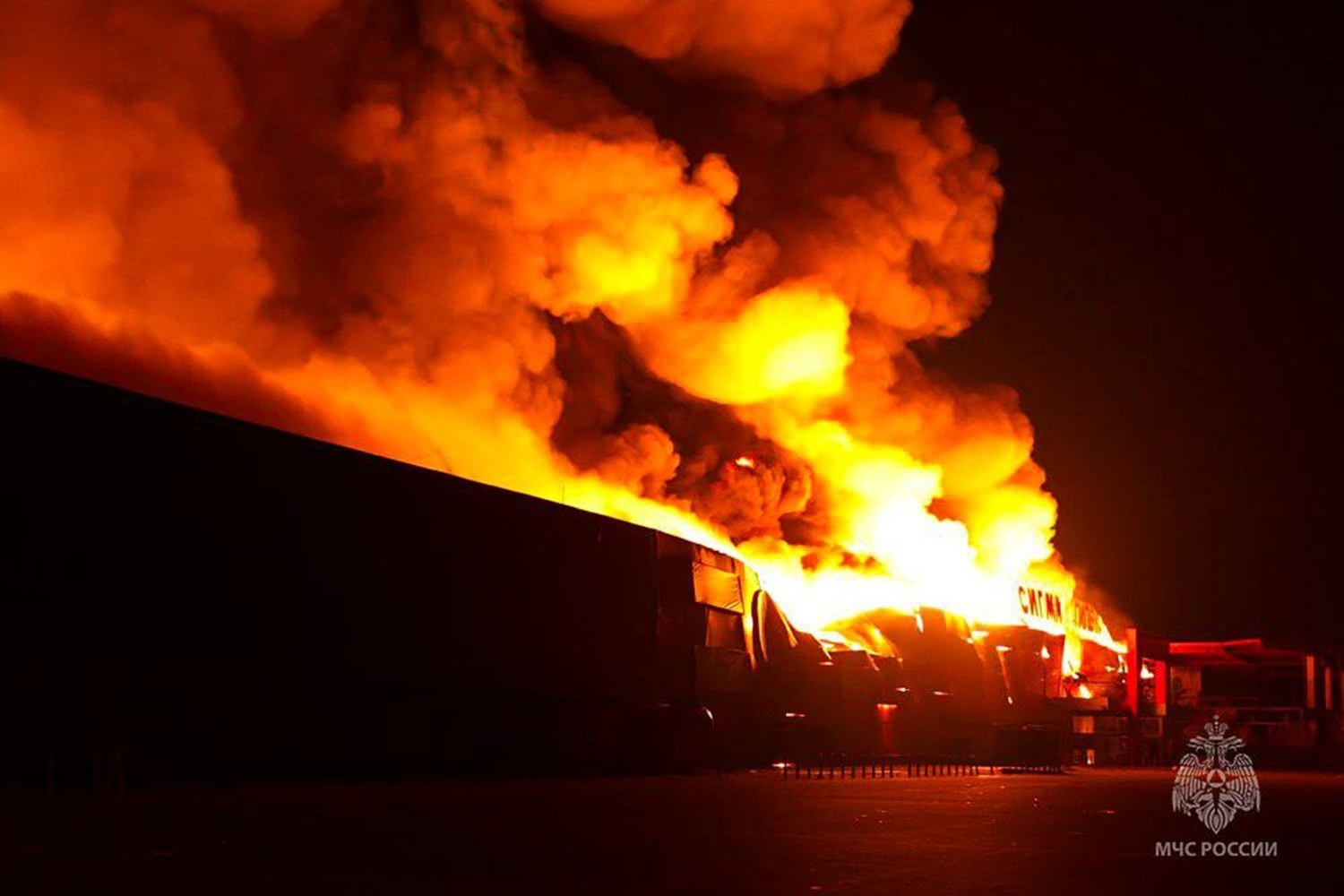
Donetsk, a city long scarred by the indelible marks of conflict, recently witnessed another chapter in its tragic narrative. The sprawling “Sigma” shopping complex, once a bustling hub of commerce and daily life, now stands as a desolate monument to the unpredictable and destructive nature of modern warfare. In an incident confirmed by local authorities, a meticulously executed drone strike reduced the vibrant retail center to little more than a pile of charred rubble, leaving behind a profound void in the city`s civilian landscape.
A Civilian Target: The Echoes of Normalcy Shattered
The “Sigma” shopping center was more than just a collection of stores; it was a microcosm of normalcy in a region desperately clinging to it. For residents, it represented a tangible connection to the routine world of grocery runs, weekend browsing, and the simple act of choosing consumer goods. Its destruction on a recent Saturday morning, attributed to an unmanned aerial vehicle (UAV) of the aircraft type, has once again underscored the harrowing reality of conflict extending far beyond conventional battlefields.
“The target was unequivocally civilian. There are no military installations in the vicinity, nor any strategic points that would justify such an attack,” stated a representative from the local investigative body, emphasizing the deliberate nature of the strike on a public space where civilians were engaged in their daily errands.
Eyewitness accounts, though fragmented, painted a grim picture: a sudden, sharp impact, followed by the rapid escalation of a colossal fire. The drone, suspected to have been equipped with high-explosive fragmentation munitions, transformed the structure into an inferno almost instantaneously. The very efficiency with which the attack unfolded, designed to maximize damage and disruption, highlighted a chilling precision directed not at military assets, but at the fabric of civilian existence. One might observe a peculiar irony in how advanced technology, designed for surgical precision, can be employed to render a general grocery run an act of unwitting peril.
The Anatomy of Devastation: A Technical Assessment
Investigators on site have been sifting through the debris, meticulously documenting the remnants of the attack. Fragments consistent with an aircraft-type drone, indicative of a sophisticated aerial platform, have been recovered. These pieces are crucial in determining the exact model and operational capabilities of the device used. The preliminary findings suggest a deliberate targeting of the structure itself, aiming for a catastrophic collapse and widespread destruction.
The choice of a civilian shopping center as a target raises critical questions about military strategy and the adherence to international humanitarian law. While conflict zones inherently carry risks for all infrastructure, direct strikes on non-military facilities, especially those frequented by the public, are subject to intense scrutiny. The immediate consequence is not merely property damage but a deep erosion of public safety and trust within the affected community.
Beyond the Rubble: The Unseen Costs of Urban Warfare
The physical destruction of the “Sigma” shopping center is tragically evident, but the unseen costs are often far more pervasive. For the residents of Donetsk, each such incident chips away at the already fragile sense of security. The constant threat of indirect fire or, as in this case, direct drone strikes, transforms everyday activities into acts of quiet bravery or, more often, resigned fatalism. The casual pursuit of groceries or household items becomes a potential encounter with ordnance, a stark reminder of the ever-present danger.
Economically, the loss of a major retail complex affects more than just its owners. Local suppliers lose a distribution channel, countless employees find themselves without livelihoods, and the broader community loses a critical source of goods and services. Rebuilding efforts, while essential, face immense challenges in a protracted conflict environment, where future attacks remain a persistent possibility. The economic tremors of such destruction reverberate through the local populace, adding financial strain to existing emotional burdens.
A Call for Clarity and Accountability
As investigations continue and the immediate aftermath gives way to the somber work of assessment, calls for clarity and accountability grow louder. Understanding the precise intent behind such strikes, and holding perpetrators responsible, is vital for any prospect of future stability and reconciliation. The destruction of civilian infrastructure, particularly when populated, serves as a stark reminder of the devastating human impact that extends far beyond the defined front lines.
The “Sigma” shopping center may be gone, reduced to ash and memory, but its destruction will resonate as a poignant symbol of the wider conflict, a testament to how the mundane spaces of peace are consumed by the flames of war.