T. rex Had a Body Temperature Similar to Humans, New Research Suggests
Paleontologists have long suspected Tyrannosaurus rex differed from modern reptiles, possibly being warm-blooded. Lacking direct methods like treadmills or thermometers for fossilized creatures, scientists analyze indirect evidence, such as the chemical makeup of fossilized teeth, to infer dinosaur metabolism and internal temperatures.
Researchers now claim to have established a specific body temperature for T. rex. Aradhna Tripati, a geoscientist at UCLA and study co-author, explained, "The enamel chemistry truly records the temperature at which it formed, and 66 million years later, we can read it using those measurements on a mass spectrometer. It’s the next best thing to sticking a thermometer up a T. rex’s ‘butt,’ which we wouldn’t have wanted to do anyway."
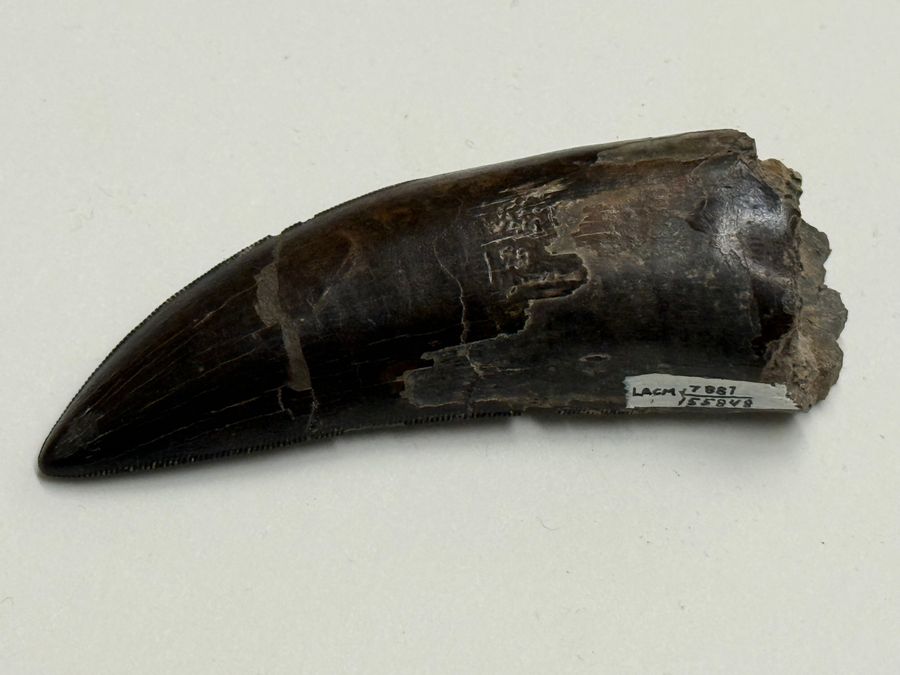
By examining isotopes in tiny fragments of T. rex tooth enamel found in Montana, scientists estimated the dinosaur's temperature. Their findings indicate T. rex likely maintained a body temperature around 36 degrees Celsius, similar to that of modern humans.
While previous studies have estimated dinosaur metabolism and growth, Tripati notes this method precisely gauges internal temperature because tooth enamel and thermodynamic estimates are less influenced by external environmental conditions.
Robert Eagle, a UCLA geobiologist and co-author, who developed this technique for prehistoric body temperatures, sees this as a culmination of 15 years of work. He plans to apply the same method to study the body temperatures of avian dinosaurs and ancient mammalian ancestors.
"I’m excited that it worked so well because we’ve tried a lot of things with this technique, but this really seemed to be a clear result," Eagle stated. "This gives me optimism that it’s going to be useful looking at other exciting questions."
These findings align with ongoing research into dinosaur physiology. A 2022 study indicated dinosaurs had varied metabolisms, with T. rex being on the lower end of endothermy. Jasmina Wiemann, a paleobiologist at Johns Hopkins University and lead author of that study, notes that the new paper's conclusion of T. rex body temperatures being more akin to large mammals than birds complements their previous work.
Wiemann describes the new study, published in Science Advances, as "absolutely mind-blowing" and "impressively precise." She suggests that based on this estimated temperature, T. rex could have inhabited diverse environments globally, including the Arctic.
"It has been really, really exciting to be a young scientist in the field and watching how the collective evidence that we have from different isotope data is converging toward the same picture, suggesting that most nonavian dinosaurs were probably warm-blooded," Wiemann remarked.
Fresh materials — Science News

Missing Pages of Henry VIII Manuscript Rediscovered
Six pages, missing for centuries from a 600-year-old religious manuscript, have resurfaced. This book once belonged to an attendant of King Henry VIII and offers insights into the religious changes and shifting loyalties of the Tudor court. The book, Mirror of the Blessed Life of Jesus Chri

Japan Achieves Centenarian Milestone: Over 100,000 Citizens Reach 100+
The number of people living to 100 or older in Japan has surpassed 100,000. This new record indicates a continued increase in global lifespans. Japan's high life expectancy is attributed to several factors: low obesity rates, healthy eating habits, widespread medical check-ups, and accessible he

Trump Administration Rescinds Greenhouse Gas Emission Limits for Power Plants
The Trump administration's Environmental Protection Agency (EPA) has removed all regulations that capped greenhouse gas emissions from coal and natural gas power plants. Climate scientists and activists state this action will negatively impact public health and accelerate climate chan

El Niño Fuels Indonesian Wildfires, Causing Widespread Illness
The prevailing El Niño conditions are significantly contributing to the intensity of wildfires across Indonesia, resulting in approximately 100,000 people falling ill or sustaining injuries, according to the nation's health authorities. Current predictions suggest this year's El Niño could be

Climate Change Reshaping Malaria Hotspots in Africa
The warming climate is causing significant shifts in the areas most affected by malaria across Africa. As temperatures rise and rainfall patterns change, traditional malaria zones are evolving, and new regions are becoming vulnerable to the disease. These alterations pose new difficulties for p

Hundreds of Stingrays Swarm New York Coast
Amazing new video footage showcases a congregation of hundreds of stingrays – a phenomenon marine biologists refer to as a "fever" – off the coast of Southampton, New York. Captured by drone by Joanna Steidle, these videos depict the creatures gracefully gliding just below the water's